

The short answer: the easiest way for children to learn duas is to tie each one to something they already do every day: waking up, eating, using the bathroom, leaving the house, getting in the car and going to sleep. Start with the shortest, such as "Bismillah" before eating and "Alhamdulillah" after, then add one new dua every week or two, saying it together at the right moment until it becomes automatic.
Below are common everyday duas from the Quran and the Sunnah, written in simple English letters with their meanings. Transliteration cannot show every Arabic sound exactly, so once your child is learning to read, it is worth learning these from the Arabic with a teacher.
Everyday duas, through the day
Waking up and going to sleep
- When waking up: "Alhamdu lillahil-ladhi ahyana ba'da ma amatana wa ilayhin-nushur." Meaning: All praise is for Allah, who gave us life after causing us to die (sleep), and to Him is the return.
- Before sleeping: "Bismika Allahumma amutu wa ahya." Meaning: In Your name, O Allah, I die and I live.
Many families also recite Al-Ikhlas, Al-Falaq and An-Nas before sleep, as the Prophet, peace be upon him, used to do. If your child knows these surahs, bedtime is the perfect time to use them.
Eating and drinking
- Before eating: "Bismillah." Meaning: In the name of Allah.
- If you forget at the start: "Bismillahi awwalahu wa akhirahu." Meaning: In the name of Allah, at its beginning and at its end.
- After eating: "Alhamdu lillahil-ladhi at'amani hadha wa razaqanihi min ghayri hawlin minni wa la quwwah." Meaning: All praise is for Allah, who fed me this and provided it for me without any power or strength from me.
For very young children, "Bismillah" before and "Alhamdulillah" (All praise is for Allah) after is a perfect start. Add the longer dua later.
Using the bathroom
- Before entering: "Allahumma inni a'udhu bika minal-khubuthi wal-khaba'ith." Meaning: O Allah, I seek refuge in You from evil and from evil beings.
- After leaving: "Ghufranak." Meaning: (I ask) Your forgiveness.
Teach children that the first is said before going in, not inside.
Leaving and entering the home
- When leaving home: "Bismillah, tawakkaltu 'alallah, wa la hawla wa la quwwata illa billah." Meaning: In the name of Allah, I place my trust in Allah, and there is no power and no strength except with Allah.
- When entering home: say "Bismillah" and greet everyone with "As-salamu alaykum" (Peace be upon you).
The leaving-home dua is a lovely one to say together at the front door on the school run.
Travelling
- When getting into a car or other transport: "Subhanal-ladhi sakhkhara lana hadha wa ma kunna lahu muqrinin, wa inna ila rabbina lamunqalibun." Meaning: Glory be to the One who has placed this at our service, for we could never have done it ourselves, and to our Lord we will surely return.
This comes from the Quran (Surah Az-Zukhruf, 43:13–14). It is longer, so teach it in two halves.
Sneezing
- The one who sneezes says: "Alhamdulillah." Meaning: All praise is for Allah.
- Whoever hears replies: "Yarhamukallah." Meaning: May Allah have mercy on you.
- The one who sneezed answers: "Yahdikumullahu wa yuslihu balakum." Meaning: May Allah guide you and set your affairs right.
Children love this one because it is a little conversation. Practise it as a game.
At the mosque
- When entering: "Allahummaftah li abwaba rahmatik." Meaning: O Allah, open the doors of Your mercy for me.
- When leaving: "Allahumma inni as'aluka min fadlik." Meaning: O Allah, I ask You for Your bounty.
Short duas from the Quran
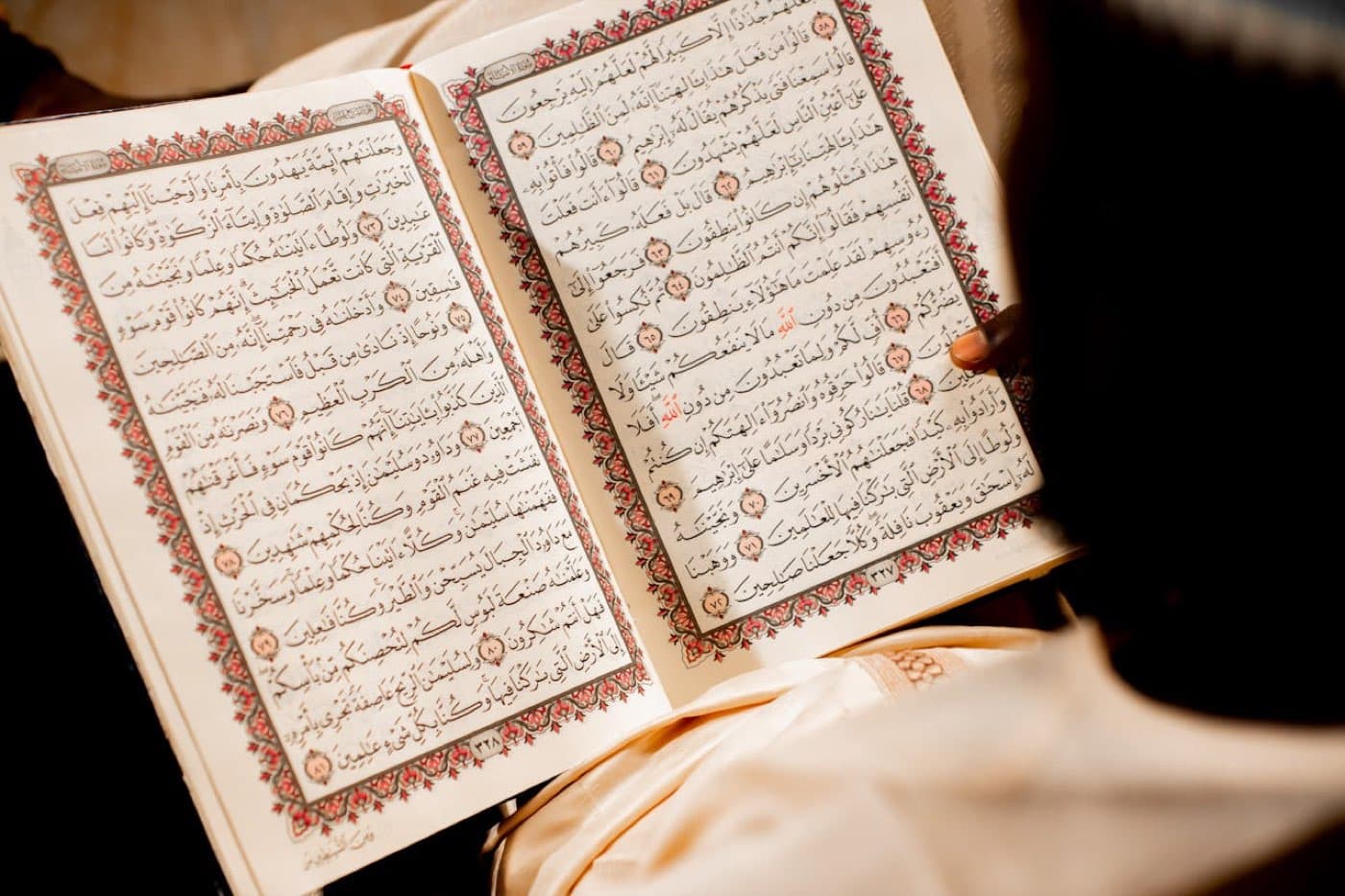
These are easy to memorize and good for any time:
- For knowledge: "Rabbi zidni 'ilma." Meaning: My Lord, increase me in knowledge. (Surah Ta-Ha, 20:114). A great one to say before Quran class or homework.
- For parents: "Rabbir-hamhuma kama rabbayani saghira." Meaning: My Lord, have mercy on them as they raised me when I was small. (Surah Al-Isra, 17:24).
- For good in both worlds: "Rabbana atina fid-dunya hasanatan wa fil-akhirati hasanatan wa qina 'adhaban-nar." Meaning: Our Lord, give us good in this world and good in the Hereafter, and protect us from the punishment of the Fire. (Surah Al-Baqarah, 2:201).
How to teach duas so they stick
- One at a time. Choose one dua and say it together at the right moment, every time, for a week or two before adding another.
- Say it out loud yourself. Children copy what they hear. If you say the eating dua at every meal, they will too.
- Teach the meaning first. A child who knows they are thanking Allah for their food says the words with more heart.
- Break long ones into chunks. Two or three words at a time, then join them up.
- Use visual reminders. A small card by the front door, on the bathroom door, or by the bed.
- Praise them for remembering, especially when they remind you.
How we teach duas
Our Islamic Studies for kids course teaches everyday duas, their meanings and correct pronunciation, alongside salah and the basics of faith, in live one-to-one classes of 30 minutes. Your child can combine it with Quran reading, so they learn to read the duas from the Arabic too. You choose a male or female teacher at the same fee.
Start with one dua today
Pick one from this list and say it together at the right moment all week. If you would like a teacher to help your child learn duas with correct pronunciation, book 3 free trial classes, no card needed.