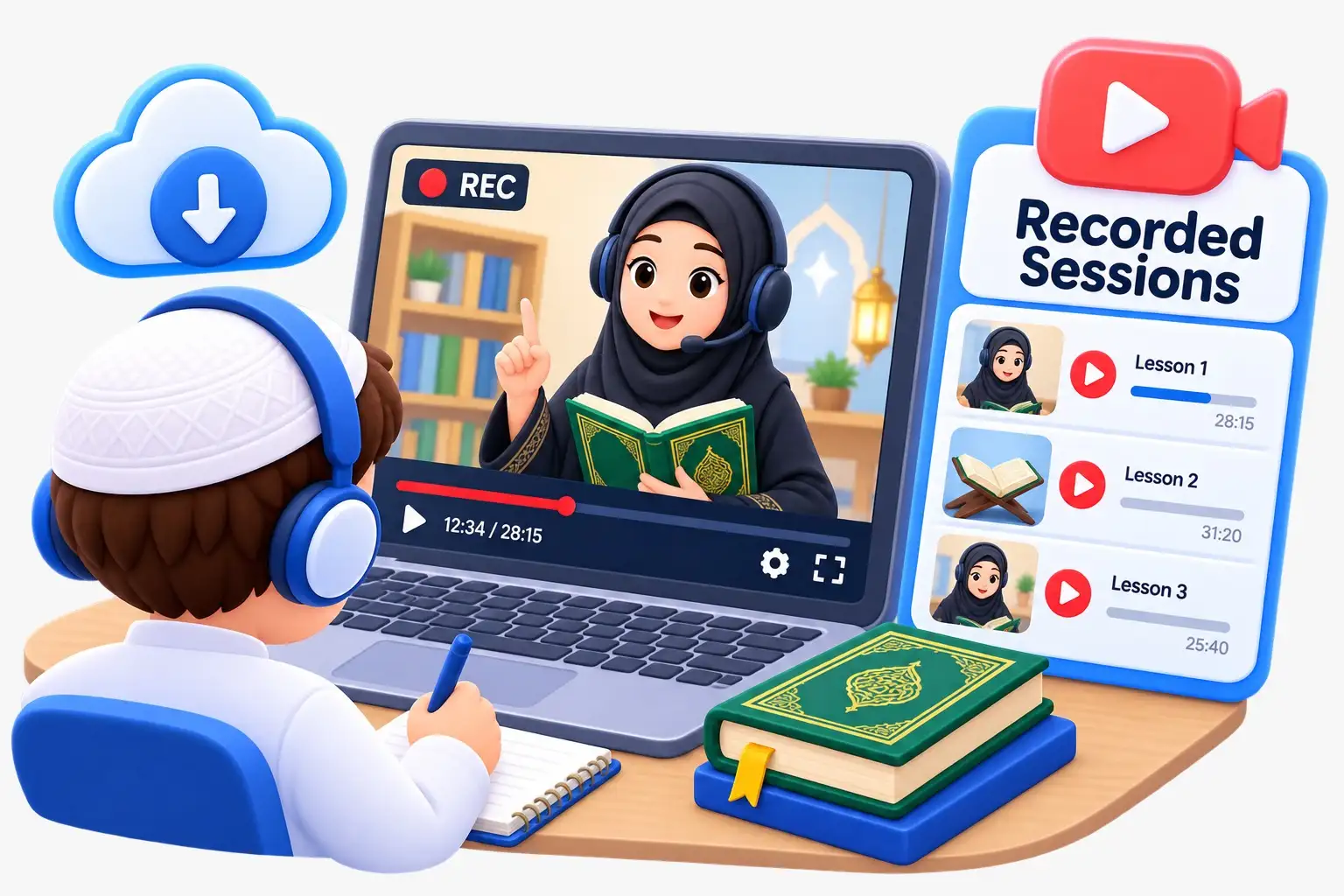
The short answer: a free trial Quran class for a child usually has four parts: a friendly welcome, a gentle level check, a short real lesson at the right level, and a quick chat with the parent at the end. Nothing is a test your child can fail. Your job is to watch how the teacher teaches and how your child responds.
Before the class
A little preparation makes the first five minutes much smoother. Our full guide to preparing your child for their first online Quran class covers it, but the essentials are:
- Test the link (Zoom, Google Meet or Skype) the day before.
- Use a laptop or tablet rather than a phone, if you can.
- Choose a quiet spot with good light, so the teacher can see your child's face.
- Have a glass of water nearby and the toilet trip done.
- Join two or three minutes early, so the start is calm.
The 30 minutes, part by part
Every teacher has their own style, and the timing below is a rough guide rather than a script. A shy four-year-old and a confident twelve-year-old will have very different trials.
| Time | What usually happens | What it is for |
|---|---|---|
| 0–5 min | Salaam, names, a few easy questions about school or hobbies | Helping your child relax and talk |
| 5–12 min | Level check: letters, a short surah, or a few lines of reading | Finding where your child really is |
| 12–25 min | A short lesson at the right level | Showing how the teacher teaches |
| 25–30 min | Praise for the child, a word with the parent | Next steps and your questions |
Minutes 0–5: the welcome
A good teacher does not start with the Quran. They start with your child. Expect simple questions: what is your name, how old are you, what did you do at school today. Shy children may only nod at first. That is fine. If your child hides behind you, a patient teacher will wait and keep smiling rather than push.
Minutes 5–12: the level check
This is not an exam. The teacher simply wants to see what your child can already do, so lessons start at the right place. Depending on age and background, they might:
- show a few Arabic letters and ask your child to name them
- ask your child to recite a surah they know, such as Al-Fatiha
- ask an older child to read a few lines from the Quran or a Qaida page
If your child knows nothing yet, that is completely normal, and the teacher will move straight to a first lesson. Letter recognition is not needed before a trial. If you would like an idea of level in advance, our Quran level test gives a quick guide.
Minutes 12–25: a real lesson
Now the teacher teaches. For a beginner, that is usually the first letters of Noorani Qaida: say the letter, your child repeats, the teacher corrects gently, repeat again. For a reader, it may be a few lines with one Tajweed point fixed. For Hifz, it could be a short new portion and how to revise it.
This is the most useful part for you to watch. You are seeing what every class would feel like.
Minutes 25–30: wrapping up
The teacher should end on something your child did well, then speak briefly to you: where your child is, what they suggest working on, and how many classes a week might suit. This is your moment to ask questions.
What parents should watch for
- Warmth. Does the teacher smile, use your child's name and stay patient?
- Correction style. Are mistakes corrected clearly and kindly, or quickly and vaguely?
- Talking time. Is your child reciting most of the time, or mostly listening?
- Level. Is the work too easy, too hard, or just a little stretching?
- Your child at the end. Are they more relaxed than at the start?
- Your own comfort. Would you be happy for this person to teach your child every week?
Our list of questions to ask in a free Quran trial class is a good companion for that final chat.
Why three trials are better than one

A first class is never quite typical. Children are nervous, connections wobble, and the teacher is still getting to know your child. That is why we offer 3 free trial classes. Use them on purpose:
- Trial 1: settling in and the level check. Sit beside your child.
- Trial 2: a more normal lesson. Sit nearby, but let your child lead.
- Trial 3: a proper class at the time you would actually book. Watch from across the room, or join for part of it.
If the timing or the teacher does not feel right after trial 1 or 2, say so. You can try a different time or a different teacher, male or female, at the same fee.
What happens after the three trials
After the trials, the decision is entirely yours. There is no card on file and nothing to cancel. If you want to continue, we agree a regular weekly time in your own time zone, keep the teacher your child liked, and you choose a monthly plan from $30 a month for one class a week. If you are not sure yet, ask anything on WhatsApp first; we usually reply within an hour.
Your first paid month also comes with a 7-day money-back guarantee, and you can change teacher free at any time after that.
Book your trials

The easiest way to know if online classes suit your child is to see one. Book 3 free trial classes, no card needed, and sit in on every one.