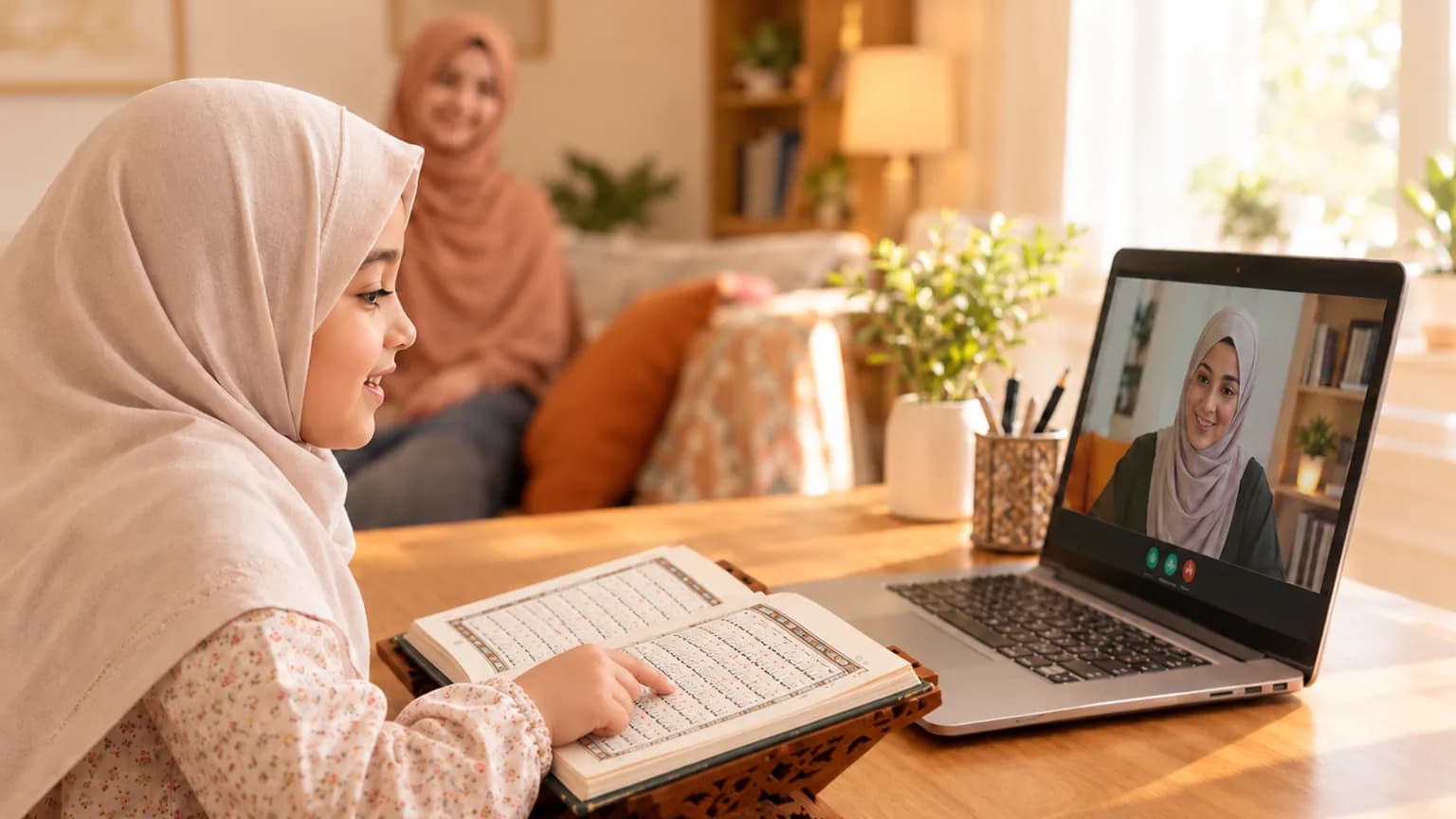
The short answer: for most children, yes: learn to read the Quran fluently (Nazra) first, then start full Hifz. A child who can read the page memorises faster, makes fewer mistakes and can revise on their own. The main exception is very young children, roughly 4 to 6, who can memorise short surahs by listening while they are still learning to read. That is a good start, but it is not a replacement for reading.
What Nazra and Hifz mean
Nazra means reading the Quran by looking at it. A child doing Nazra reads from the mushaf, page by page, with the teacher correcting pronunciation and Tajweed. Hifz means memorising the Quran by heart, usually a few lines at a time, with daily revision.
The usual path for a child looks like this:
- Noorani Qaida: the Arabic letters, joining, vowels and basic rules. Most children take about 6–12 months.
- Nazra: reading the Quran itself, slowly at first, until the child reads steadily with few mistakes.
- Hifz: memorising, starting with Juz Amma or with Surah Al-Baqarah, depending on the teacher and the family's goal.
Many families also memorise short surahs throughout, long before formal Hifz. That is normal and good.
Why most teachers prefer Nazra first
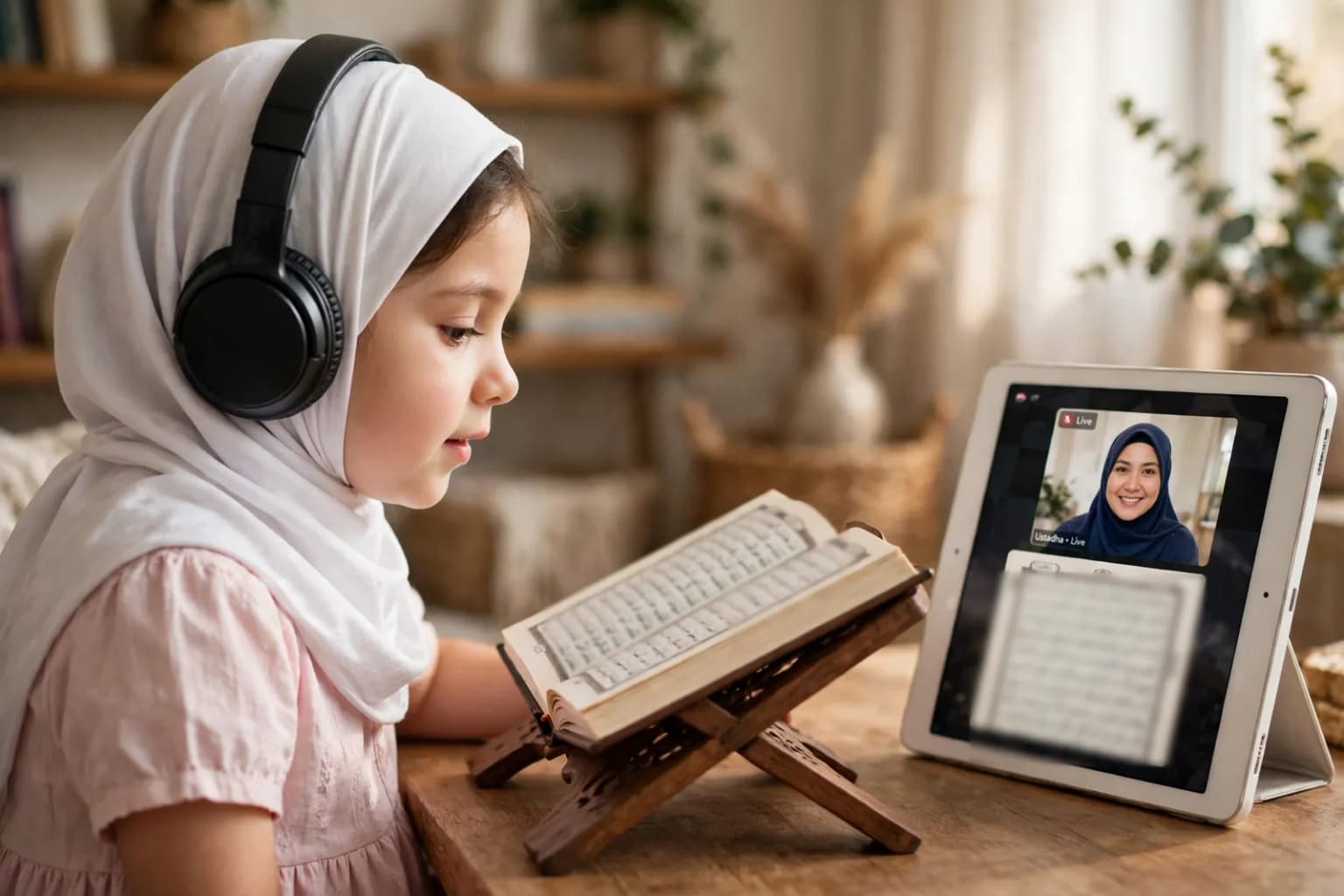
- The page becomes a tool. A child who can read looks at the lines, recites them, closes the book and tries again. A child who cannot read has to wait for someone to say the verse aloud every time.
- Fewer mistakes get memorised. If a child memorises by ear and mishears a letter, the mistake goes into memory. A reader can check the page and see the right letter.
- Revision is possible alone. Hifz is mostly revision. Readers can revise their old lessons (manzil) from the mushaf without an adult sitting beside them.
- Tajweed is already in place. In Nazra the teacher fixes the sounds once. In Hifz, the child can then focus on memorising rather than relearning how to say ح or ع.
The case for starting Hifz earlier
There are real reasons some families start memorising before reading is complete:
- Young memories are strong. Many 4- to 6-year-olds pick up a recited surah after hearing it a few times.
- Short surahs are needed now. A child learning to pray needs Al-Fatiha and a few short surahs, whatever their reading level.
- Confidence. Knowing surahs by heart can make a young child proud and keen to keep going.
So the question is not really "Hifz or Nazra", but "how much memorising, of what, at what reading level".
Comparing the two routes
| Nazra first, then Hifz | Memorising by listening, alongside reading | |
|---|---|---|
| Best age | Usually 7 and over | Usually 4–6 |
| What gets memorised | Any part of the Quran, in a planned order | Short surahs, mostly from Juz Amma |
| Accuracy | High: the child can check the page | Depends on how carefully the teacher listens |
| Revision | The child can revise from the mushaf alone | A parent or teacher must recite with the child |
| Risk | Can feel slow to start | Mistakes heard early can stick; reading may be neglected |
The exception: very young memorisers
If your child is 4, 5 or 6, memorising by listening can work very well, as long as three things are true:
- Reading continues. Noorani Qaida carries on in every class. Memorising is extra, not instead.
- A teacher listens closely. Short surahs are heard and corrected letter by letter, so early mistakes are caught.
- The goal stays small. Al-Fatiha and the short surahs at the end of the Quran, not whole juz. Our list of short surahs for kids to memorise first is a good order.
Once your child reads steadily, they can move into a proper Hifz plan. Our guide to when to move from Qaida to the Quran explains that step.
How to know your child is ready to switch

- They read an unfamiliar page of the Quran with only a few small mistakes.
- They can sit through a 30-minute reading class without losing focus.
- They have memorised a few short surahs and still remember them weeks later.
- They want to memorise, not only their parents.
For a fuller checklist, read is my child ready for Hifz? Readiness matters more than age.
A middle path many families take
Many children do a mix for a year or so: most of the class is Nazra, and the last few minutes are spent memorising a few lines of Juz Amma. When reading is strong, the balance flips: most of the class becomes Hifz, with reading practice built into revision. Our Nazra classes and Juz Amma memorisation pages show how each part works.
Let a teacher assess your child

It is hard to judge reading level at home, especially if you do not read Arabic yourself. In a free trial, the teacher listens to your child read and tells you honestly whether to start with Nazra, Hifz or a mix. Our classes are live and one-to-one: 30 minutes for reading, 45 minutes for Hifz, on the same monthly plans. Book 3 free trial classes, no card needed, and ask the teacher for a reading assessment in the first lesson.