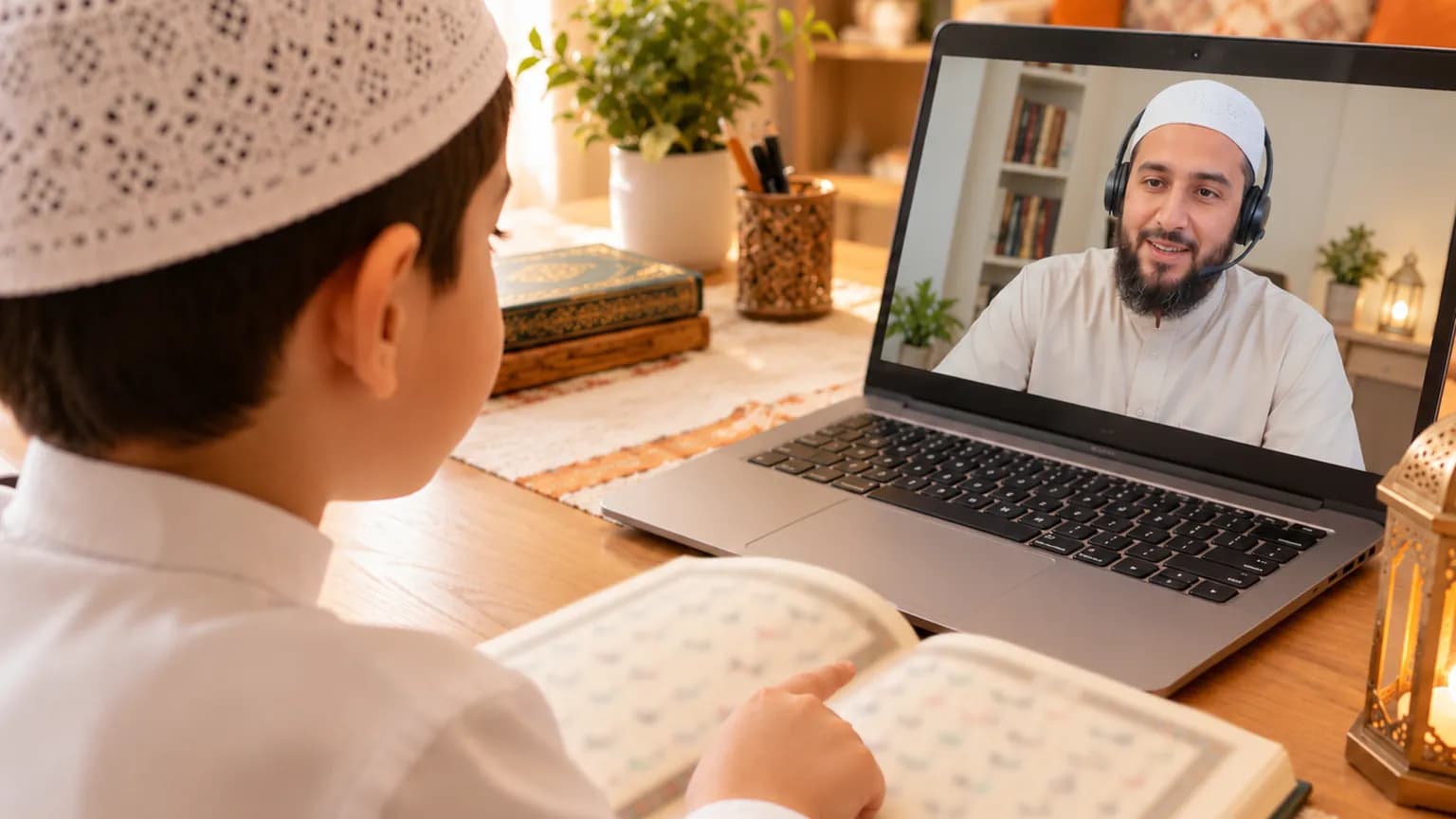
The short answer: your child is ready to move from Noorani Qaida to the Quran when they can read an unfamiliar line from the last pages of the Qaida slowly but correctly, without guessing: every letter, vowel, sukoon and shaddah, with long vowels held for the right length. Speed is not the test; accuracy is. Most teachers then start with short surahs from Juz Amma, the last part of the Quran, and build up from there.
Why readiness matters more than the last page
Many parents treat the end of the Qaida like the end of a school year: last page done, next book please. But a child can reach the last page and still be unsure of some rules, especially if the earlier pages were rushed. The Quran itself has denser lines, smaller print and longer words than the Qaida. Gaps that were small in the Qaida feel much bigger there.
Most children take about 6–12 months to finish the Qaida; our guide to how long Noorani Qaida takes explains the range.
Signs your child is ready

- They read new words, not just familiar pages. Give them a line they have not practised. If they read it slowly but correctly, that is a strong sign.
- They do not guess look-alike letters. ب, ت and ث, or ج, ح and خ, are read by their dots every time.
- Vowels are steady. Fatha, kasra and damma are never swapped, and tanween is clearly heard.
- Long vowels are held. They stretch the madd letters for about two counts and do not stretch the short ones.
- Sukoon and shaddah are joined properly. No extra vowel is added to a stopped letter, and doubled letters are clearly stressed.
- Heavy and light letters are mostly right. Not perfect, but clearly different.
- They can concentrate for a full line. A Quran line is longer than most Qaida lines; your child should be able to follow it without losing their place.
If most of these are true, your child is ready. If two or three are shaky, a few more weeks of Qaida revision will pay off.
The bridge: from Qaida to Juz Amma
Most teachers do not jump straight from the Qaida to the first page of Al-Baqarah. They use the short surahs at the end of the Quran, in Juz Amma, as a bridge. These surahs are short, the child often already knows some of them by heart, and they bring together every rule from the Qaida in real Quranic text.
| Step | What your child reads | What the teacher focuses on |
|---|---|---|
| 1. Short surahs | Al-Fatiha, then the shortest surahs such as Al-Ikhlas, Al-Falaq and An-Nas, read from the page | Reading the page, not reciting from memory |
| 2. The rest of Juz Amma | Longer surahs from the same juz | Steady reading of longer lines, first Tajweed rules |
| 3. The start of the Quran | Al-Baqarah onwards, a few lines at a time | Stamina, smoothness and applying the rules |
| 4. Regular reading | A set amount each class | Fluency, Tajweed and confidence |
Some teachers go straight to the start of the Quran after the Qaida, and some families prefer it. Both work. The point is to start with short, manageable amounts and build up. Our guide to short surahs for kids to memorise first has a good order for the bridge surahs.
A tip for children who already know the short surahs
If your child memorised Juz Amma before they could read, they may recite from memory while looking at the page. A teacher will check by pointing to words in the middle of a verse, or by starting with a surah your child does not know.
What if my child moved on too early?
It happens often, and it can be fixed. Common signs:
- Reading is very slow, with long pauses on most words.
- The same few letters or rules are wrong again and again.
- Your child guesses words from the first letter.
- They are frustrated, or say the Quran is too hard.
The fix is not always to go back to page one. A good teacher will find the specific gap, such as sukoon or long vowels, and spend a few lessons on the right Qaida pages while keeping some Quran reading in every class, so the child does not feel they are going backwards. Our guide to restarting the Quran after a long break has a similar approach.
How the timeline continues
After the bridge, most children read slowly at first and become smoother over the following months. Our post on how long it takes a child to learn to read the Quran shows the full timeline, and Tajweed rules for kids explains what the teacher will focus on next.
Let a teacher check readiness

The surest way to know is to have a teacher listen to your child read an unfamiliar line. In our live one-to-one classes, the teacher checks readiness before moving on, uses the bridge surahs, and tells you honestly where your child is. You can also take our free Quran level test for a quick first idea. Book 3 free trial classes — no card needed — and ask the teacher whether your child is ready for the Quran.