

The short answer: start with Surah Al-Fatiha, because it is recited in every unit of every prayer. Then teach Al-Ikhlas, Al-Falaq and An-Nas, which are short and said every day. After that, work backwards through the last surahs of the Quran, from An-Nasr and Al-Kawthar towards Al-Qadr and Az-Zalzalah, choosing the shorter ones first. A few lines learned well and revised every day beat a long list learned quickly and forgotten.
Below is the order we suggest, why it works, and how to make the surahs stick without turning it into a battle.
Why short surahs come first
Short surahs give a child quick wins. A three-verse surah can be learned in a few days, and finishing one gives a real sense of pride that carries them into the next. They are also the surahs a child hears and uses most: in their own prayers, in the prayers they hear at home and in the mosque, and at bedtime. A surah your child uses every day is one they will not forget.
Most of these surahs come from the last part of the Quran, called Juz Amma (the thirtieth juz). That is why many teachers and Islamic schools teach it from the end backwards: the surahs near the end are the shortest.
The order we suggest

Stage 1: the essentials
| Surah | Number | Verses | Why first |
|---|---|---|---|
| Al-Fatiha | 1 | 7 | Recited in every unit of every prayer |
| Al-Ikhlas | 112 | 4 | Very short, and teaches the oneness of Allah |
| Al-Falaq | 113 | 5 | Recited daily for protection, often at bedtime |
| An-Nas | 114 | 6 | Recited daily together with Al-Falaq |
Once your child knows these four well, they have everything they need to pray, and the evening routine of reciting the last three surahs before sleep becomes something you can do together.
Stage 2: the next short surahs
| Surah | Number | Verses |
|---|---|---|
| Al-Kawthar | 108 | 3 |
| Al-Asr | 103 | 3 |
| An-Nasr | 110 | 3 |
| Quraysh | 106 | 4 |
| Al-Masad | 111 | 5 |
| Al-Fil | 105 | 5 |
| Al-Kafirun | 109 | 6 |
| Al-Ma'un | 107 | 7 |
These are all short and give a child lots of variety for their prayers. Some teachers prefer to go strictly in the order of the Quran, from An-Nas backwards. Others, like the table above, start with the very shortest. Either works, so follow what your child's teacher is doing so you are not pulling in two directions.
Stage 3: slightly longer surahs
| Surah | Number | Verses |
|---|---|---|
| Al-Qadr | 97 | 5 |
| Al-Humazah | 104 | 9 |
| At-Takathur | 102 | 8 |
| Az-Zalzalah | 99 | 8 |
| Al-Qari'ah | 101 | 11 |
| Al-Adiyat | 100 | 11 |
Verse counts here follow the common Hafs numbering used in most printed copies. By the time a child reaches this stage, they usually find longer verses much easier than they would have at the start, because their ear and memory are trained.
A bonus many families add: Ayat al-Kursi
Ayat al-Kursi is a single verse from Surah Al-Baqarah (2:255), not a short surah, but many parents like their children to learn it early because it is often recited after prayers and before sleep. It is longer than any verse in the tables above, so it usually fits best after Stage 2.
How fast should a child go?
There is no prize for speed. For a young child of four to six, one short surah every week or two is a good pace. Children of seven and older can often learn a new one every few days, as long as the old ones are still solid. If you want a feel for longer-term goals, our guide on how long it takes a child to learn to read the Quran covers the reading side, and our realistic guide to memorizing the Quran covers the bigger Hifz journey.
A five-minute routine that makes surahs stick
- Listen first. Play a slow, clear recitation of the new surah a few times during the day, in the car or at breakfast. Young children absorb a surprising amount just by hearing it.
- One verse at a time. Say a verse, let your child repeat it three or four times, then move on. When they have two verses, join them together before adding a third.
- Repeat the whole surah. Once all the verses are in, recite the full surah together several times.
- Use it straight away. Ask your child to recite their new surah in their next prayer, or at bedtime. Using it is the best revision there is.
- Revise the old ones daily. Spend a minute or two going over the surahs they already know. Old surahs are forgotten when they stop being used, not because they were learned badly.
Teach a little meaning too
Children remember what they understand. You do not need a full tafseer. One or two sentences in simple words is enough: Al-Fil is the story of an army with an elephant that came to attack the Kaaba; Al-Kawthar is about a great gift Allah gave the Prophet; Al-Asr says that time is precious. A child who knows what a surah is about is far less likely to mix it up with another one.
Getting the pronunciation right
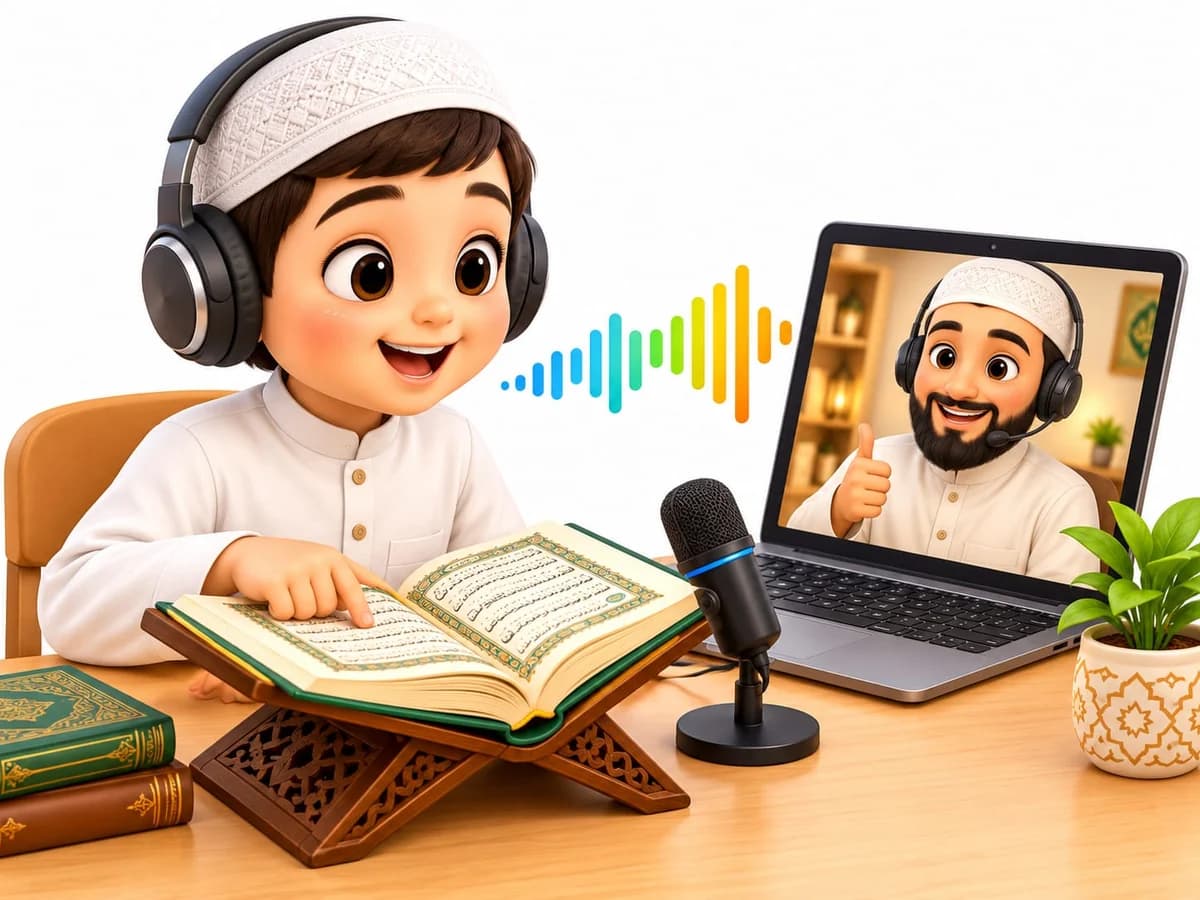
This is the one part a parent cannot easily do alone. A child who memorizes a surah with a wrong sound will repeat that mistake for years, and it is much harder to fix later than to learn correctly at the start. That is why we suggest a teacher listens to each new surah before it counts as done, even if most of the memorizing happens at home. It also helps to learn to read alongside memorizing, starting with the Noorani Qaida, so your child can check the words on the page themselves.
Common mistakes to avoid
- Rushing to the next surah before the current one is solid.
- Relying only on transliteration for older children who can learn the Arabic letters. It is fine for a toddler to learn by ear, but written English letters cannot show the real sounds.
- Stopping revision once a surah is learned. Weekly revision of everything is what keeps it.
- Turning it into a test. Praise effort more than speed. A child who loves reciting will keep learning for life.
How we help at Online Quran Lessons

Our teachers memorize short surahs with children in live one-to-one classes, 30 minutes each, alongside learning to read. The teacher listens to every surah, fixes pronunciation as they go, and gives you a short list of what to revise at home between classes. You choose a male or female teacher, and classes run 24 hours a day, 7 days a week, so you can pick a time that suits your child. Read more about our online Quran classes for kids and our Quran memorization course.
Start with one surah this week
Pick the next surah from the list above and try the five-minute routine for a week. If you would like a teacher to check your child's recitation and plan the next steps, book 3 free trial classes. No card is needed, and you can sit beside your child for every one.