
The short answer: children stay motivated when they feel they are getting better, feel close to the people they read with, and understand why the Quran matters. So praise effort rather than speed, read as a family, set goals small enough to win every week, use rewards to celebrate rather than to bribe, and keep connecting what they read to their own life.
Motivation is something you grow, not something you add
This guide is about the everyday habits that build a child's own wish to read. If your child is actively refusing class, start with my child refuses Quran class: what to do. If they used to enjoy it and have gone flat, our page on Quran classes for kids who lost interest looks at fresh starts. What follows works best before either of those happens.
Researchers who study motivation often describe three things that help people want to do something for its own sake: feeling capable, feeling connected to others, and having some say in it. All three apply neatly to a child learning the Quran.
1. Help them feel capable

A child who feels they are getting better wants to keep going. A child who feels stuck wants to stop.
- Praise the effort, not the talent. "You worked really hard on that tricky letter" builds more than "You're so clever."
- Be specific. "Your ع sounded just like the teacher's today" shows you were really listening.
- Show them how far they have come. Once a month, let them read a page from a few months ago. It will feel easy now, and that is a powerful moment.
- Keep the level right. If every lesson is a struggle, ask the teacher whether the pace is too fast. If it is always easy, they may need a challenge. Our guide on how to check your child's Quran progress shows what to look for.
2. Help them feel connected
Children want to do what the people they love do, with them.
- Family reading time. Ten minutes a few evenings a week when everyone reads or recites something: a parent with their own Quran, an older sibling, the youngest with their Qaida. Children copy what they see far more than what they are told.
- Let them recite to someone. Grandparents on a video call, a parent at bedtime, a younger sibling. An audience who is delighted makes the effort feel worthwhile.
- Lead the prayer at home. Once a child knows a few short surahs, letting them recite in a family prayer can be a huge moment.
- A teacher they like. Children work harder for someone they feel close to. If the relationship is not working, change teacher; at Online Quran Lessons that is free, at any time.
3. Give them some say
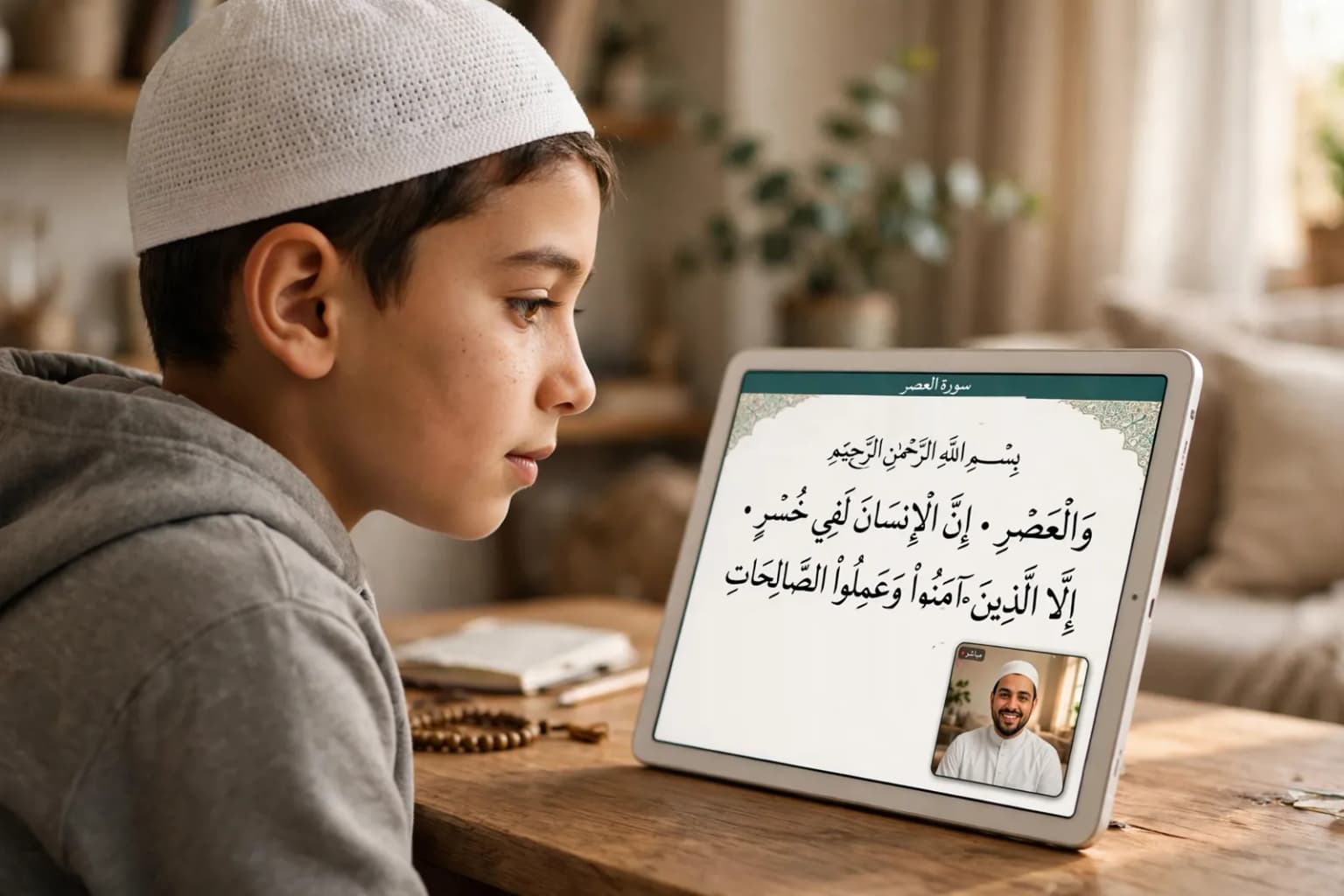
- Let them choose which surah to memorise next, from two or three you suggest.
- Let them help pick the class time, especially from age 9 or so.
- Let them decide how to track progress: a chart, a notebook, a jar of marbles.
Small choices give a child ownership. It becomes their Quran journey, not just yours.
Small goals they can win every week
Big goals like "finish the Qaida" or "memorise Juz Amma" are too far away to feel real. Break them down until your child can reach one every week.
| Big goal | Weekly goal a child can win |
|---|---|
| Finish Noorani Qaida | Read this week's lesson without help |
| Read the Quran fluently | Read three lines with no mistakes |
| Memorise Juz Amma | Learn three new lines and revise last week's |
| Pray with confidence | Recite one new surah in prayer this week |
For memorising, our guide to how much Quran a child should memorise a day helps set a realistic pace.
Rewards done right

Rewards are not wrong, but how you use them matters. A reward promised in advance for every task ("read and you get sweets") can teach a child that reading is a chore you have to be paid for. A reward that celebrates something already achieved is different.
- Celebrate milestones, not every class. Finishing a Qaida lesson, a new surah or the whole Qaida.
- Make rewards about time together where you can: a trip to the park, choosing dinner, a special outing.
- Use visible progress. A sticker chart or a progress map is a reward in itself for many children.
- Never take away Quran as a punishment or use it as one. It should never be the thing that happens when they misbehave.
Link the meaning to their life
Children are far more motivated when they understand what they are reading. Even before they know Arabic, you can share the meaning in simple words.
- Before bed, tell them in one sentence what a surah they know is about.
- Connect verses to their day: kindness to parents, telling the truth, being grateful.
- Tell the stories behind the Quran: the prophets, the people of the cave, Musa and Fir'awn. Our guide to teaching kids about the prophets is a good place to start.
- Learn duas that link to daily life, such as before eating or sleeping; see daily duas for kids with meanings.
If your child reads fluently but has no idea what the words mean, see my child reads Quran but does not understand it.
Things that quietly kill motivation

- Correcting every mistake at home, straight after the teacher has already done it.
- Comparing them with a sibling, a cousin or a child at the mosque.
- Talking about Quran class as something to "get through".
- Never noticing when they have done well.
A teacher who builds confidence
In our live one-to-one classes, the teacher works only with your child, sets small goals they can reach, and praises real effort. You can join any class to see it for yourself. Book 3 free trial classes, no card needed, and ask the teacher how they keep children motivated.