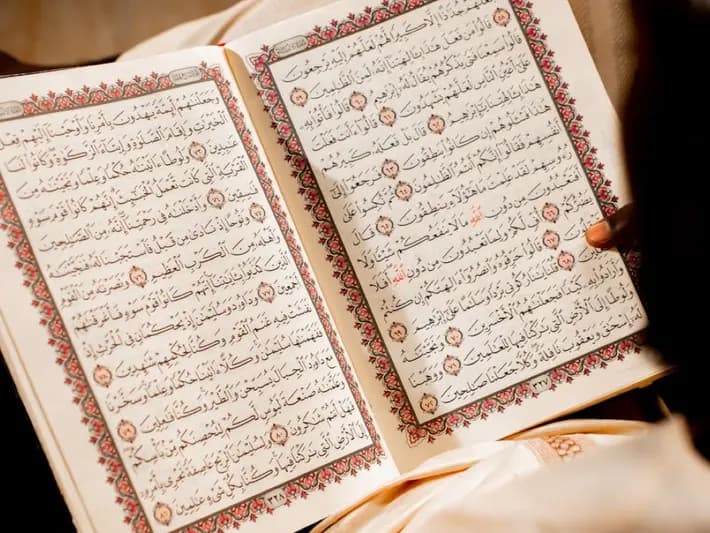
The short answer: *madd* means stretching the sound of one of the three long-vowel letters (ا و ي). The basic natural madd is 2 counts. It becomes longer when it is followed by a hamzah (4 or 5 counts) or by a sukun (2, 4 or 6 counts, or always 6 when the sukun is permanent). A "count" (*harakah*) is roughly the time it takes to say one short vowel.
The madd letters
- ا after a fathah: قَالَ
- و with a sukun after a dammah: يَقُولُ
- ي with a sukun after a kasrah: قِيلَ
The chart (Hafs recitation)

| Type | When it happens | Counts | Example |
|---|---|---|---|
| Natural madd (tabi'i) | A madd letter with no hamzah or sukun after it | 2 | قَالَ · نُوحِيهَا |
| Connected madd (muttasil) | A madd letter followed by a hamzah in the same word | 4 or 5 (must be lengthened) | جَاءَ · السَّمَاءِ · سُوءَ |
| Separated madd (munfasil) | A madd letter at the end of a word, hamzah at the start of the next | 4 or 5 | بِمَا أُنْزِلَ · إِنَّا أَعْطَيْنَاكَ |
| Madd for a temporary sukun ('arid lis-sukun) | A madd letter before the last letter, when you stop on it | 2, 4 or 6 | الْعَالَمِينْ · نَسْتَعِينْ (stopping) |
| Compulsory madd (lazim) | A madd letter followed by a permanent sukun or shaddah | 6 | الضَّالِّينَ · الْحَاقَّةُ |
| Soft madd (lin) | و or ي with a sukun after a fathah, before the last letter, when stopping | 2, 4 or 6 | خَوْفْ · قُرَيْشْ (stopping) |
| Substitute madd (badal) | A hamzah followed by a madd letter | 2 | آمَنُوا · إِيمَانًا |
| Exchange madd ('iwad) | Stopping on a tanween with fathah | 2 | عَلِيمًا → عَلِيمَا |
| Minor connecting madd (silah sughra) | The pronoun هُ / هِ between two vowels, not followed by a hamzah | 2 | إِنَّهُ كَانَ |
| Major connecting madd (silah kubra) | The same pronoun followed by a hamzah | 4 or 5 | مَالَهُ أَخْلَدَهُ |
Keep your lengths consistent
Where a madd can be read at more than one length, such as munfasil (4 or 5) or 'arid lis-sukun (2, 4 or 6), choose one length and keep to it throughout your recitation. Switching between lengths in the same reading is a common mistake. The connected madd (muttasil) should never be shorter than the separated madd (munfasil).
Madd in the opening letters of surahs

Some surahs begin with separate letters, such as الٓمٓ. Each letter is read by its name. Letters whose names have three sounds with a madd in the middle, like لَامْ and مِيمْ, are stretched 6 counts (a form of madd lazim). Letters with two-sound names, like حَا in حمٓ, take a natural 2-count madd. A small wavy line (ٓ) in the mushaf marks the long ones.
Common mistakes
- Cutting the natural madd short, so قَالَ sounds like *qala*.
- Over-stretching the natural madd to 4 counts in normal reading.
- Reading the compulsory madd (lazim) less than 6 counts, as in the end of Surah Al-Fatiha.
Related: Surah Al-Fatiha for kids, waqf signs and noon sakin rules. To have a teacher check your madd lengths, book 3 free trial classes. See how our online Tajweed course works.