

The short answer: many autistic children learn to read and memorise the Quran, and some find it deeply calming. What helps most is predictability (the same teacher, time and lesson pattern), a quiet setting, clear small steps, and a teacher who adapts to how your child communicates. Every autistic child is different, so start from your child, not from a standard plan.
Why routine matters so much
For many autistic children, not knowing what will happen next is stressful in itself. A Quran lesson that follows the same pattern every time (greeting, revision, one new step, a favourite recitation to finish) lets the child relax into it. Keep the same day and time each week, and tell your child in advance if anything has to change.
The setting

- Quiet and familiar. A busy madrasah room can be overwhelming: noise, lights, many children. Learning at home, in a spot your child already feels safe in, removes much of that.
- Sensory comfort. Headphones at a comfortable volume, soft lighting, a chair or cushion your child likes. Let them wear what feels comfortable.
- Camera choices. In online lessons, some children prefer the teacher's camera on and their own off at first. That is fine.
How to teach
- Show, then do. Point to the letter, say it, and let the child copy. Visual steps ("first this line, then this line, then finished") help a child see the end of the task.
- One instruction at a time, in short, plain words.
- Use their strengths. Many autistic children have an excellent memory for sounds. Listening to a calm reciter and repeating can be the quickest route to memorising short surahs.
- Interests as a bridge. If your child loves patterns, letters, or numbers, use them: count the verses, spot repeated words, colour the letters.
- Allow processing time. Wait a few seconds after a question before repeating it.
- Echoing is a start. If your child repeats lines without yet reading them, that is still connection with the Quran, and reading can follow later.
Children who are non-speaking or have limited speech

Listening to the Quran is itself an act of worship, and a child who cannot recite aloud can still learn to recognise surahs, follow along with a finger, and sit with the Quran calmly. Some children recite quietly to themselves, or only with a parent. Let the teacher know how your child communicates, so the lesson can work with it.
Choosing a teacher
- One teacher who stays the same, rather than whoever is free that week.
- Patience with repetition, and no pressure to make eye contact.
- Willing to hear from you about what helps and what upsets your child.
- Happy for you to sit in on every lesson.
A short trial lesson is the honest way to see whether your child settles. Changing teacher should be easy if the match is not right.
At home
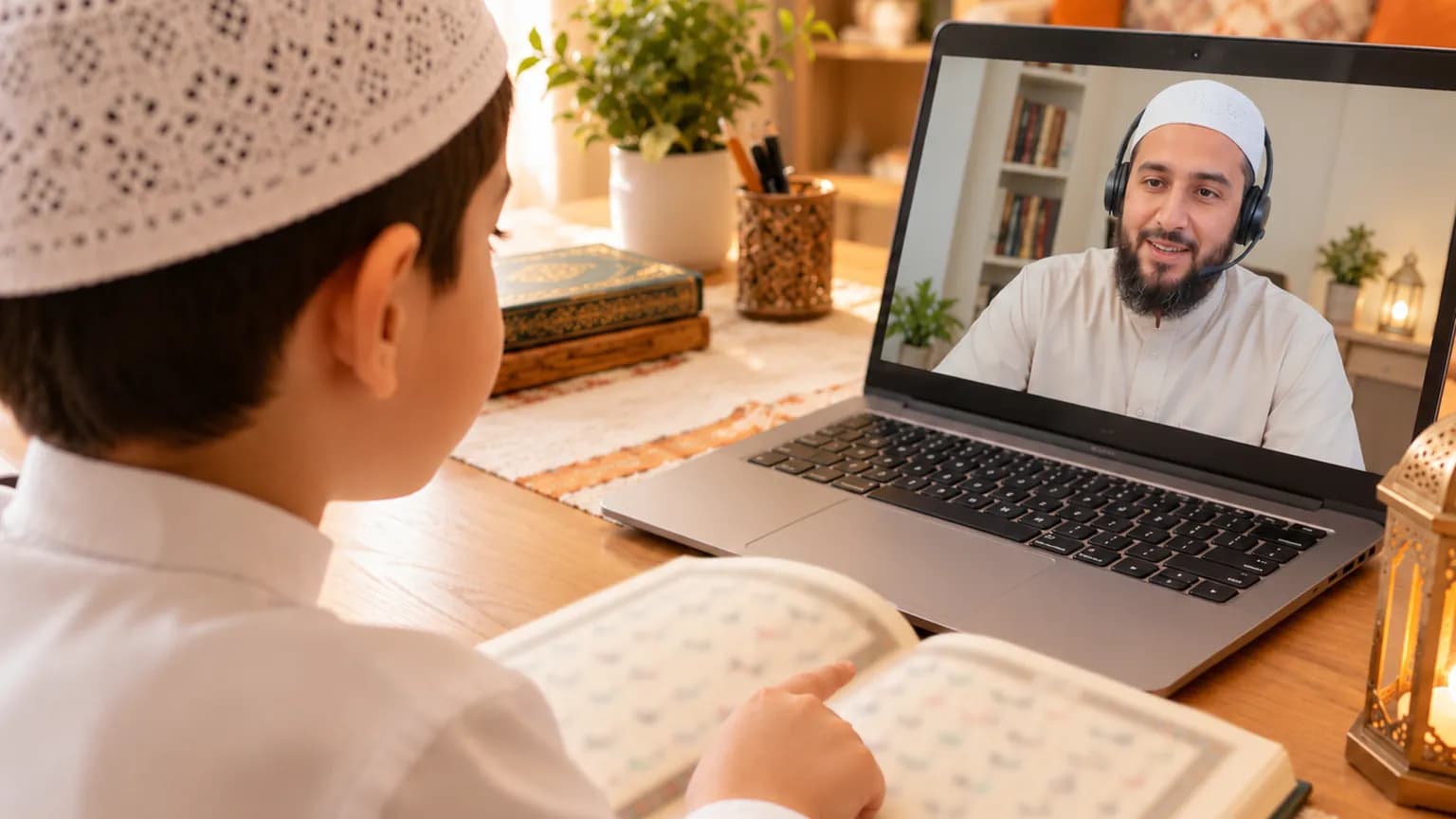
- Play the surah your child is learning at a regular time, such as in the car or before bed.
- Keep practice short and in the same place.
- Celebrate small steps: a new letter, a full verse, sitting through the whole lesson.
- Read about what to do when Arabic letters get mixed up if reading is the sticking point.
A note on expectations
Your child's path may be slower, faster, or simply different. Allah does not burden a soul beyond what it can bear (Al-Baqarah 2:286). What matters is that your child's experience of the Quran is calm and loving, so the connection lasts.
This guide is about Quran lessons. For an assessment, therapy or support at school, speak to your GP, paediatrician or your child's school.
Our Quran classes for children with additional needs are one-to-one, with the same teacher at the same time every week, and you can sit beside your child throughout. You can book 3 free trial classes to see how your child responds.