

The short answer: most children who start between five and seven, with three short one-to-one classes a week, finish the Noorani Qaida in about three to six months and are reading short surahs from the Quran itself within a year. Reading smoothly with the basic rules of Tajweed usually takes another year or two. Older children often move faster through the early stages. The biggest difference, though, is not age. It is how regularly your child reads aloud to someone who corrects them.
Every parent who books a first class asks some version of this question. Here is the honest answer, stage by stage, so you know what to expect and can tell whether your child is on track.
What "reading the Quran" actually means
Parents often mean different things by it, so it helps to split it into three goals:
- Reading on their own: your child can open the mushaf and sound out the words correctly, even if slowly.
- Reading fluently: your child reads at a steady pace, without stopping on every word.
- Reading with Tajweed: your child applies the rules of correct recitation, such as lengthening sounds and the rules of noon and meem, consistently.
These come in that order. A child who can read on their own after a year is doing well, even if fluency and Tajweed are still a work in progress.
The stages, with typical timings

This is the path most of our students follow with three 30-minute classes a week. Treat the timings as a guide, not a deadline.
| Stage | What your child learns | Typical time |
|---|---|---|
| 1. Letters and sounds | The Arabic letters, their shapes and how to pronounce each one | 4 to 8 weeks |
| 2. Joining letters | How letters change shape when they join into words | 3 to 6 weeks |
| 3. Vowel marks | Short vowels, tanween, long vowels, sukoon and shaddah | 2 to 3 months |
| 4. Finishing the Qaida | Basic reading rules and longer practice words | 1 to 2 months |
| 5. Short surahs | Reading the last part of the Quran (Juz Amma) from the page | 3 to 6 months |
| 6. Fluent reading with Tajweed | Reading longer passages smoothly and applying the rules | 1 to 2 years |
Stages 1 to 4 are the Noorani Qaida. If you would like to see what each lesson covers, our Noorani Qaida lesson plan for kids goes through it step by step.
How age changes the timeline
Ages 4 to 5
Young children can absolutely start, but they move more slowly, and that is fine. Their attention lasts about ten to fifteen minutes, and they are still learning to hold a pencil and sit still. Expect the Qaida to take closer to six months or more. The goal at this age is to love the lessons and pronounce the letters correctly, not to race.
Ages 6 to 9
This is the age most children start, and often the easiest. They can focus for a full 30 minutes, they are used to reading at school, and they enjoy seeing their progress. Many finish the Qaida in three to five months and are reading short surahs within the first year.
Ages 10 to 14
Older children usually get through the early stages faster, because they understand instructions and can practise on their own. The challenge is different: they may feel shy about starting "late", and they have more homework and clubs competing for time. A teacher who keeps lessons brisk and respectful of their age makes a big difference.
If you are unsure whether your child is ready, our guide to the best age to start Quran classes covers the signs to look for.
How classes a week change the timeline

The number of lessons matters more than their length. A rough guide for a child of six to nine:
| Classes a week | Finishing the Qaida | Reading short surahs on their own |
|---|---|---|
| 1 | Often 9 months or more, with lots of repeating | Hard to predict |
| 2 | Around 5 to 7 months | Around 12 to 15 months |
| 3 | Around 3 to 5 months | Around 9 to 12 months |
| 5 | Around 2 to 4 months | Around 6 to 9 months |
One class a week is the slowest option by far, because a child forgets much of a lesson in seven days and the next class starts with catching up. Two is the minimum we suggest. Three is where most children make steady, visible progress.
What speeds it up
- Reading aloud for most of the lesson. The child should be reading, and the teacher listening and correcting, not the other way round.
- Five minutes on days without a class. Ask your child to read yesterday's page to you. You do not need to know Arabic to listen and encourage.
- The same teacher every week. A teacher who knows your child remembers exactly which letters they mix up.
- Fixing pronunciation early. A sound learned wrong in the first month takes far longer to fix in the second year.
- A fixed time. Classes that move around get missed. Pick a slot your child can keep all year.
What slows it down
- Long gaps. A month off over the holidays often means repeating several weeks of pages.
- Skipping the Qaida. Going straight to the Quran with weak letters usually means stopping later to go back.
- Transliteration. Reading Arabic words written in English letters feels like a shortcut, but it gets in the way of learning the real sounds.
- Comparing with other children. Every child moves at their own pace. A child who reads slowly but correctly is doing better than one who reads quickly with mistakes.
Signs your child is on track
Rather than watching the calendar, watch for these. After the first month, your child should know most of the letters by sight. After three months, they should be joining letters and reading short words with vowel marks. By the end of the Qaida, they should read a new line slowly but without needing help on every word. If your child has been stuck on the same few pages for several weeks, talk to the teacher. It usually means something small needs fixing, not that your child is behind.
How we teach it at Online Quran Lessons
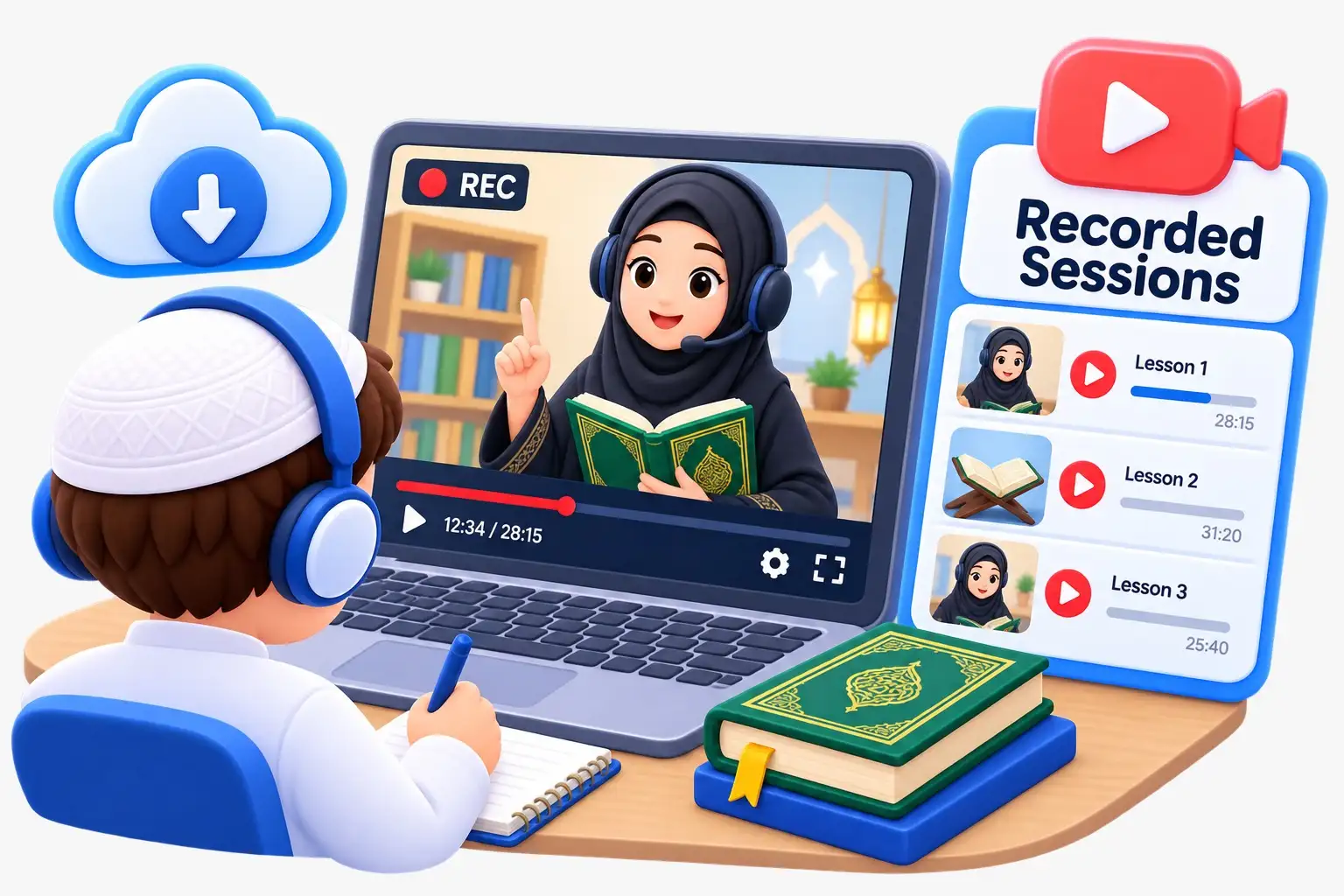
Every class is live and one-to-one, 30 minutes long, with the same male or female teacher each week, and you can sit in on any lesson. Classes run 24 hours a day, 7 days a week, so you can choose a time that suits your child's school day wherever you live. In the first free class the teacher listens to your child read and gives you an honest estimate of how long the Qaida will take for them. You can read more about our online Quran classes for kids or compare plans on the fees page.
See where your child starts
The quickest way to get a real answer for your own child is a real lesson. Book 3 free trial classes, no card needed, sit beside your child and hear them read. After three classes, you will know exactly where they are and how long the road ahead looks.