
The short answer: give each child their own level and their own short one-to-one class, rather than one shared lesson that is too hard for the youngest and too easy for the eldest. Then simplify the family side: stack the classes back to back or at the same time of day, share one daily practice slot, let older siblings help without becoming the teacher, and celebrate each child's progress without comparing them.
Here is how families with children at different stages make it work.
Why one shared lesson rarely works
A five-year-old learning letter shapes, a nine-year-old reading the Quran slowly and a fourteen-year-old memorizing need completely different lessons. In a shared class, the teacher's attention is split, the youngest gets lost, the eldest gets bored, and the middle child spends most of the time waiting. Quran reading is also a skill that improves when a teacher hears the student read aloud and corrects them immediately, which is hard to do with several children at once.
Separate one-to-one classes do not have to mean more hassle. With a little planning, they can fit into one block of the day.
Plan by stage, not by age

Siblings often sit at very different points regardless of age. A rough way to group what each child needs:
- Pre-readers (often under six): short surahs by listening, the Arabic letters, and simple duas. A gentle start on the Noorani Qaida when they are ready.
- Beginner readers: the Noorani Qaida, then moving into the Quran. Two or three classes a week is plenty.
- Fluent readers: Quran reading with Tajweed, plus memorizing short surahs, and perhaps Islamic Studies.
- Older or keen children: Hifz, Tajweed or understanding meaning, often with more classes a week.
An older child who never learned to read properly is not a problem; they simply start at the beginning, usually moving faster than a younger sibling would. Nobody needs to know who is on which page.
Make the timetable simple
The logistics are what usually defeat busy parents. Some approaches that help:
- Back to back. One child at 5:00, the next at 5:30, the next at 6:00, all on the same days. Quran time becomes one fixed block in the evening.
- Same device, same spot. Set up one quiet corner and rotate children through it.
- Different days for different needs. The Hifz student might have five classes a week while the youngest has two, but on shared days, line them up together.
- Weekends to ease the load. Moving one class per child to the weekend can take pressure off school nights.
Our guide on how many Quran classes a week a child needs helps you decide each child's number.
One shared practice slot
You do not need separate home practice sessions for every child. A single 15 to 20 minute family Quran time works well:
- Everyone sits together with their own book.
- Each child reads their own lesson aloud in turn, youngest first, while the others read quietly.
- Finish with a short surah everyone knows, recited together.
This builds a family habit, lets younger children hear older ones recite, and means you only need to find one slot in the day. For a simple routine, see how to revise Quran at home between classes.
Using older siblings well
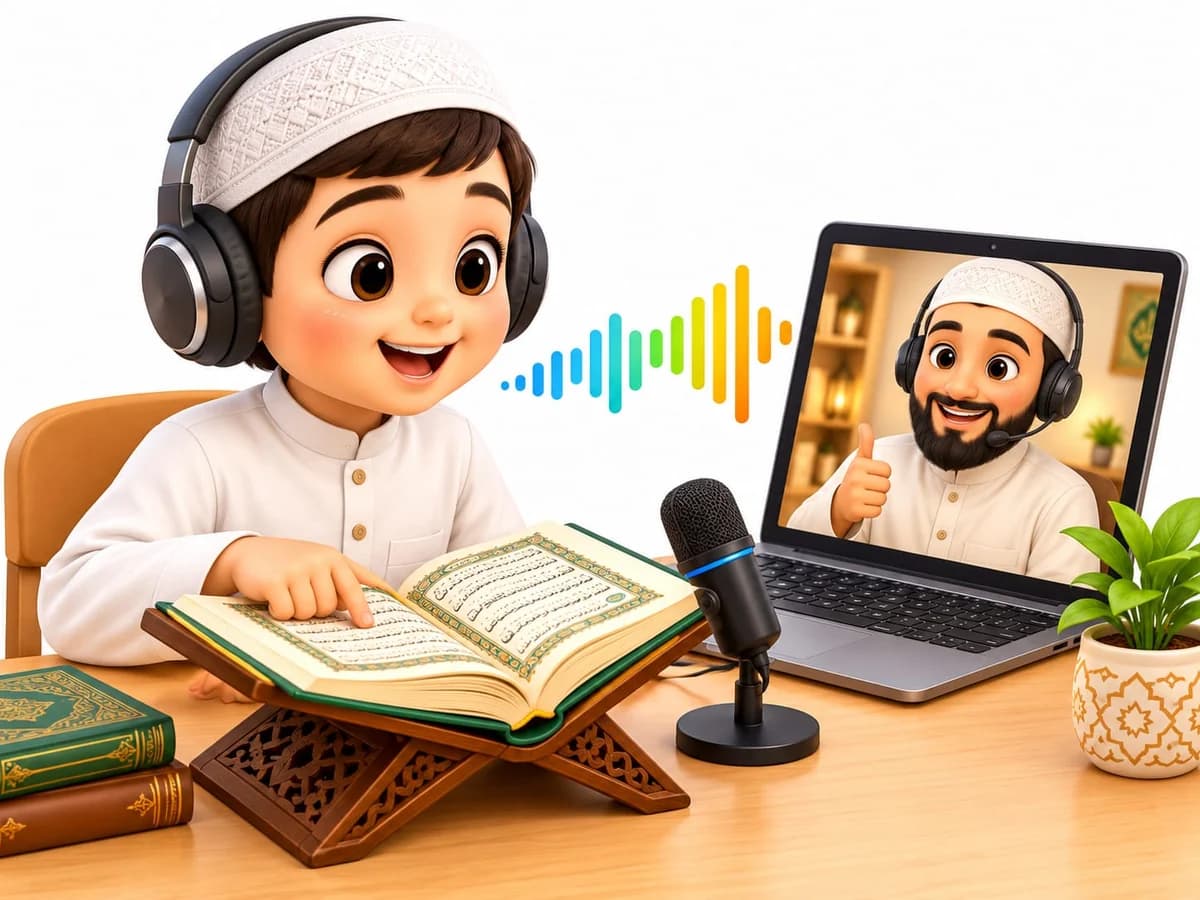
Older siblings can be a real help, but there is a line between helping and teaching.
- Good roles: listening to a younger sibling read their lesson, reciting a surah for them to copy, reminding them of practice time, or reading together at family Quran time.
- Roles to avoid: being responsible for correcting pronunciation, being the main teacher, or being blamed when a younger child does not practise.
Helping a younger sibling can be genuinely good for the older child, because explaining something deepens your own understanding. But it should feel like an honour, not a burden.
Avoid comparisons
Comparisons between siblings are easy to make and hard to undo. "Your little brother already knows that surah" might be meant as encouragement, but it usually lands as shame. Instead:
- Praise each child against their own progress: "Last month you couldn't read this page, and now you can."
- Celebrate milestones separately, so each child has their own moment.
- Keep progress charts personal, not on a shared leaderboard.
Children progress at different speeds for many reasons: age, personality, how much they like reading, even who their teacher is. None of that is a contest.
Choosing teachers for each child

Siblings do not need the same teacher. A shy younger child may do best with a gentle female teacher, while an older son doing Hifz might prefer a male teacher. If you are unsure, see male or female Quran teacher for your child. Keeping each child with a consistent teacher matters more than everyone sharing one.
How we work with families
At Online Quran Lessons each child has their own live one-to-one class of 30 minutes, at their own level. Siblings can be booked back to back, classes run 24 hours a day, 7 days a week, and there is a 10% family discount from the second child. Each child can have a male or female teacher at the same fee, and you can sit in on any class. Read more about our online Quran classes for families or see the pricing page.
Try it with all your children

The free trial works for each child, so every sibling can meet their teacher before you commit. Book 3 free trial classes, no card needed, and tell us how many children you would like to enrol.