

The short answer: start by letting your child pray beside you and copy the movements long before they are expected to pray. Then teach it in layers: first the movements, then wudu, then Al-Fatiha and a short surah, then the other phrases of the prayer, and finally the five daily times. The Prophet, peace be upon him, taught that children should be told to pray when they reach seven, so the years before that are for gentle, joyful practice, and the years after are for building a steady habit.
This guide gives you a simple order to follow. For details that differ between schools of thought, such as exactly where to place the hands, follow what your family and local mosque teach.
Before seven: let them copy you
Young children learn by imitation. Long before formal teaching, let your child stand beside you on a small prayer mat and do what you do. They will bow when you bow, prostrate when you prostrate, and probably wander off halfway through. That is fine. What they are learning is that prayer is a normal, loved part of the day.
- Give them their own small mat. Ownership makes it special.
- Pray where they can see you, at least sometimes.
- Do not correct every movement. Enjoy that they want to join in.
Five steps to a complete prayer
Step 1: the movements
Before any words, teach the shape of the prayer. Practise it as a calm, slow sequence:
- Standing (qiyam), facing the qibla.
- Raising the hands to begin, saying "Allahu Akbar".
- Bowing (ruku), back straight, hands on the knees.
- Standing up again from the bow.
- Prostrating (sujud), forehead, nose, palms, knees and toes on the ground.
- Sitting briefly between the two prostrations, then the second prostration.
- Sitting at the end of the second unit and the final unit.
- Turning the head to the right and then the left to finish, saying the salam.
Explain that one set of standing, bowing and two prostrations is one unit, called a rak'ah. Make a game of naming each position.
Step 2: wudu
Teach wudu at the sink as a routine, not a lecture. Do it alongside them a few times, then let them lead while you watch. The basic order most children learn is:
- Make the intention and say "Bismillah".
- Wash the hands.
- Rinse the mouth and the nose.
- Wash the face.
- Wash the arms up to and including the elbows, right first.
- Wipe over the head with wet hands, and the ears.
- Wash the feet up to and including the ankles, right first.
Many families teach washing most parts three times; the essentials are washing each part properly. A picture chart by the sink helps young children remember the order.
Step 3: Al-Fatiha and a short surah
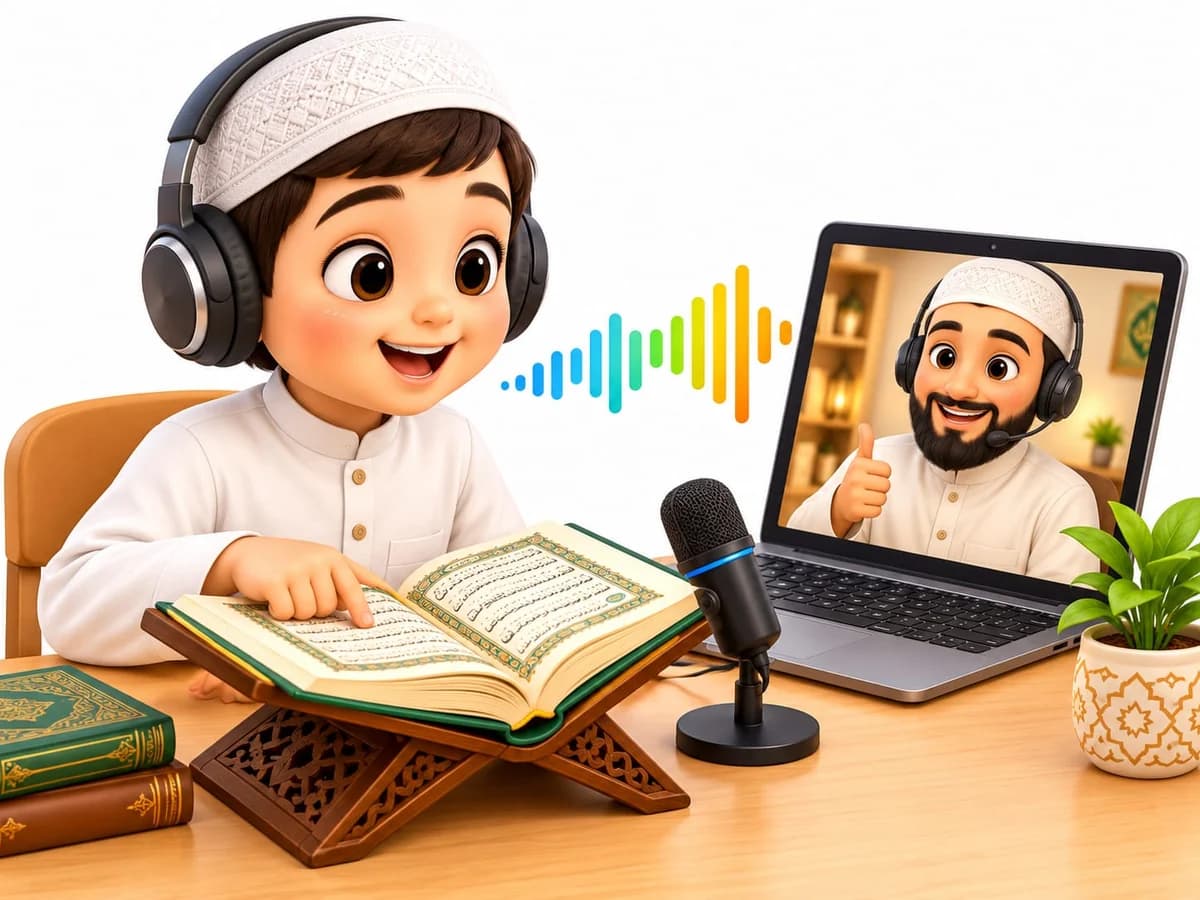
Al-Fatiha is recited in every unit of every prayer, so it is the first thing to memorize. Then add a short surah to recite after it in the first two units, such as Al-Ikhlas, Al-Kawthar or Al-Asr. Our guide on which short surahs kids should memorize first suggests an order.
Getting the pronunciation right matters here, because these are words your child will say many times a day for the rest of their life. A teacher listening to their Al-Fatiha is well worth it.
Step 4: the other words of the prayer
Once the movements and Al-Fatiha are comfortable, add the short phrases for each position, one at a time:
- In ruku: "Subhana Rabbiyal-Azim" (Glory be to my Lord, the Most Great).
- Rising from ruku: "Sami'allahu liman hamidah" (Allah hears the one who praises Him), then "Rabbana wa lakal-hamd" (Our Lord, to You be all praise).
- In sujud: "Subhana Rabbiyal-A'la" (Glory be to my Lord, the Most High).
- When sitting: the tashahhud, and in the final sitting, the salawat on the Prophet.
- To finish: "As-salamu alaykum wa rahmatullah" to the right and to the left.
The tashahhud and salawat are the longest pieces, so teach them last and in small chunks, a line a week if needed. Until then, a young child can still pray with what they know.
Step 5: the five prayers and their units
Now connect it to the day. Teach the names and rough times of the five prayers: Fajr at dawn, Dhuhr after midday, Asr in the afternoon, Maghrib after sunset and Isha at night. Then the number of obligatory units: two for Fajr, four for Dhuhr, four for Asr, three for Maghrib and four for Isha.
A simple chart on the fridge, with a space to tick each prayer, makes the day's pattern visible.
Building the habit after seven
From around seven, the aim shifts from practice to regular prayer. Some ideas that help:
- Start with one or two prayers. Maghrib and Isha are often easiest for school-age children, since they fall when the family is home. Add others gradually.
- Pray together. Praying in congregation at home, with your child beside you, is the strongest teacher.
- Use reminders, not nagging. A calm "It's Maghrib, let's pray" works better than repeated warnings.
- Praise consistency. Notice a week of prayers, not just a perfect one.
- Explain why. Short, simple talks about who we are praying to and why build real motivation.
Keep the tone loving. A child who connects prayer with warmth and family is far more likely to keep praying as a teenager than one who connects it with arguments.
Common sticking points
- Rushing. Remind them gently that prayer is calm, and model it yourself.
- Forgetting how many units they have prayed. Teach them to count on their fingers between units, or pray beside you until it settles.
- Losing focus. Pray in a quiet spot with no screens, and keep the first prayers short.
- Embarrassment at school. Older children may feel awkward praying away from home. Talk about where and how they can pray, and reassure them.
How our Islamic Studies classes help
Our Islamic Studies for kids course covers wudu, salah and the daily practices of a young Muslim in live one-to-one classes of 30 minutes, at your child's pace. The teacher can also listen to your child's Al-Fatiha and surahs to make sure the pronunciation is right. You choose a male or female teacher at the same fee, and you can sit in on any class.
Let a teacher help

If you would like support teaching your child to pray, book 3 free trial classes, no card needed. Tell us your child's age and what they already know, and the teacher will start from there.