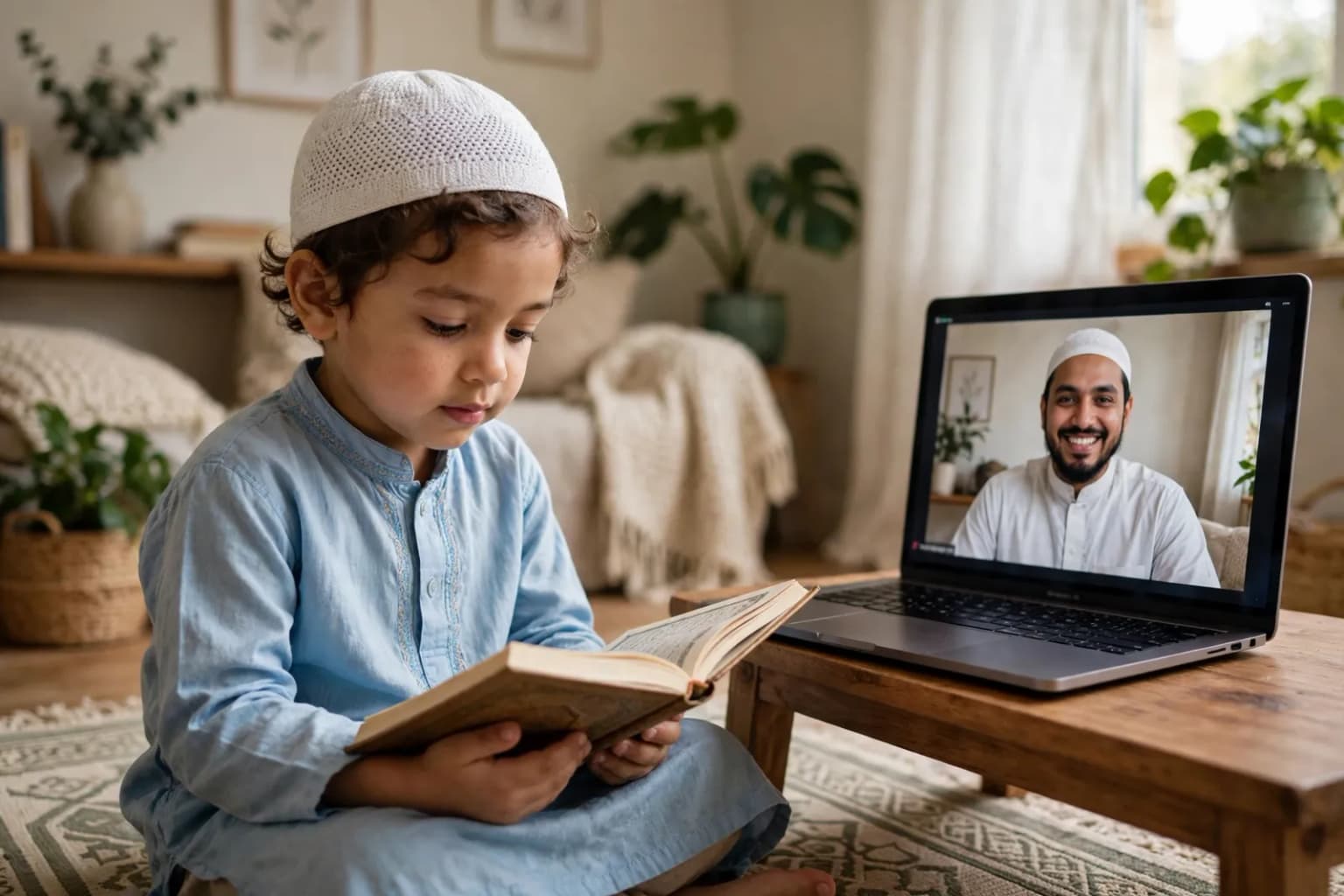
The short answer: for most children in Germany, a live one-to-one Quran class of 30 minutes, two or three times a week, at a fixed time in German time works best. If your child comes home at lunchtime, a mid-afternoon slot is usually the easiest. If they stay at the Ganztag or Hort until 3 or 4pm, book a slot around 5pm, before dinner. Keep the class going through the Ferien instead of pausing it, and add five minutes of reading at home on the other days.
This guide is for Muslim parents in Berlin, Hamburg, Cologne, Frankfurt, Munich, Stuttgart, the Ruhr and smaller towns, whether the local mosque runs a weekend class or there is no regular children's class nearby at all.
Why the German school day changes the plan
In many other countries, school runs until mid-afternoon and the Quran class goes in the evening. Germany is different. Many Grundschule children finish between 11:30 and 1pm, while others stay at the Offene Ganztagsschule (OGS) or Hort until 3 or 4pm. Once children move to secondary school, some days end at lunchtime and others run into the afternoon, and the timetable often changes each school year.
That means there is no single right time for every family. What matters is choosing a slot that suits your child's actual week, then keeping it at the same clock time so it becomes a habit.
Slots that suit most families in Germany
| Child | Classes a week | Suggested time (German time) |
|---|---|---|
| Age 5 or 6, starting the Qaida, home at lunchtime | 2 | Mid-afternoon, around 3 or 3:30pm, after lunch and a short rest |
| Age 6 to 10, at OGS or Hort until 4pm | 2 or 3 | Around 5 or 5:30pm, before dinner |
| Age 10 to 13, at Gymnasium, Realschule or Gesamtschule | 3 | On days that finish early, or early evening after homework |
| Two or three siblings | 2 or 3 each | Back to back on the same afternoons |
Try not to pin the class to Maghrib. In Germany, Maghrib can be after 9:30pm in June and before 4:30pm in December, so a class tied to prayer time will move by hours over the year. A fixed clock time is far easier for children and parents.
Time zones and the clock change

Germany runs on Central European Time, and the clocks go forward on the last Sunday in March and back on the last Sunday in October. If an academy schedules lessons in the teacher's time zone, your child's class can suddenly jump by an hour twice a year, which is one of the most common reasons families miss lessons.
At Online Quran Lessons, classes run 24 hours a day, 7 days a week, and you choose the slot in your own German time. A class at 4pm in Cologne stays at 4pm every week, before and after the clocks change.
Working around Verein training and weekends
Football, swimming, gymnastics and music lessons are a big part of childhood in Germany, and training usually happens on weekday afternoons with matches at the weekend. A few habits help the Quran class survive a busy week:
- Give the Quran class its own days. If training is on Tuesday and Thursday, book Quran on Monday, Wednesday and perhaps Friday.
- Do not rely on Saturday alone. Matches, tournaments, birthday parties and family visits take Saturdays more often than you expect. Put at least one class on a weekday.
- Move the slot, not the habit. If a new training timetable clashes after the summer, change the day or time rather than stopping for months.
- Keep it short and regular. Two or three 30-minute classes are easier to protect than one long session, and children remember more when they read often.
The language question
This is the question parents in Germany ask most. Your child reads the Quran itself in Arabic sounds, but the teacher still needs to explain, encourage and correct in a language your child understands.
At Online Quran Lessons our teachers teach in English, with Urdu on request. We do not teach in German, and we say so before you book. Many children in Germany start English at primary school, and in the early stages of the Qaida a lot of the lesson is the teacher saying a sound and the child repeating it, so short, simple English is often enough. Some families also choose Urdu because it is spoken at home.
If your child speaks only German, sit with them for the first lessons and see how they get on. The free trial classes are the best way to find out whether English instruction works for your child, before you pay anything. For a wider look at language, time zones and school days across Europe, read our parent's guide to online Quran classes in Europe.
Keeping going through the Ferien
School holidays in Germany are set by each state, so families in Bavaria, North Rhine-Westphalia and Berlin can be on holiday at different times. There are usually autumn holidays (Herbstferien), Christmas holidays, Easter holidays, about six weeks in summer, and in some states Whitsun holidays (Pfingstferien) too.
- Keep classes running through short breaks. Pausing for every holiday can cost a child many weeks of reading over a year. Without homework, the Ferien are often the easiest time to keep going.
- Plan for travel. If you visit family abroad in the summer, an online class can usually continue from there. Tell the teacher the local time in advance so the slot can be checked.
- Use the long summer well. Six weeks without school is a good time to add a class a week, finish a stage of the Qaida or start learning short surahs.
Ramadan in the German winter
For the next few years Ramadan falls in late winter in Germany, with shorter days and an early iftar, often before 6:30pm. That makes Ramadan easier for children than the long summer fasts of recent years, but evenings fill up quickly with iftar, family and taraweeh.
A class straight after school, well before iftar, often works better during Ramadan than an evening one. A few weeks before Ramadan, ask your child's teacher about a simple Ramadan goal, such as a short surah to memorise or a daily page to read. Our Ramadan Quran reading plan guide has ideas you can adapt for children.
Choosing a teacher you can trust
When the teacher is online, you need other ways to judge them. Look for:
- The same teacher every week, so they learn how your child reads and what they find difficult.
- A choice of male or female teacher. Many families prefer a female teacher for daughters or for younger children. At Online Quran Lessons you can choose either at the same fee.
- The right starting point. Beginners usually start with Noorani Qaida, which teaches the Arabic letters, their sounds and how they join, step by step.
- Open classes. You can sit in on any class, and lessons can be recorded on request, which helps if a parent works late shifts.
Fees in euro
Plans are one-to-one, 30 minutes a class, paid monthly. With 2, 3, 4 or 5 classes a week, they cost €36, €45, €50 or €55 a month. The pricing page shows the current fees in euro, and there is no registration fee.
Getting started
A short school day does not have to mean a rushed Quran routine. Choose a fixed slot in German time, protect it from training and the Ferien, and listen to your child read for a few minutes on the other days. See how online Quran classes for kids work, read more about online Quran classes in Germany, and when you are ready, book 3 free trial classes. No card is needed, and you can sit in on every one.