

The short answer: online Quran classes can be safe, and in some ways easier to keep an eye on than a class you cannot see. But safety does not come from the word "online" or from a nice website. It comes from a few habits: you can watch any lesson, the class happens in a shared room, all contact goes through a parent, and the academy answers your questions plainly. If an academy cannot agree to those, choose another one.
This checklist is written for parents in the UK, but it works wherever you live.
What "safe" should mean for an online class
When parents ask us whether online classes are safe, they usually mean three different things:
- Who is my child talking to? A real, qualified teacher who stays the same, not a stranger who changes every week.
- What can happen in the lesson? Nothing you would not be comfortable seeing, because you can see it.
- What happens outside the lesson? No private messages, social media contact or requests that bypass you.
The questions below cover all three.
Questions to ask before you book

- Can I sit in on any class, without warning? The answer should be a simple yes.
- Can lessons be recorded if I ask? Being able to look back at a class is reassuring, especially in the first few weeks.
- Will my child have the same teacher every week? Continuity is good for learning and it means you get to know the teacher.
- Can I choose a male or female teacher? Many families prefer a female teacher for daughters, or for younger children of either gender.
- How does the teacher contact us? It should be through you, the parent, never directly through your child's own phone or social media.
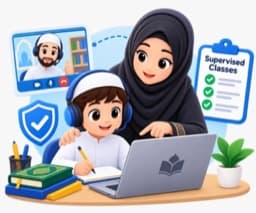
- Are classes supervised? Ask how the academy checks on lessons and what happens if you raise a concern.
- What happens if we are unhappy with the teacher? You should be able to switch without a fuss.
Notice what is not on the list: big promises. Be wary of any academy that answers safety questions with slogans instead of specifics.
Setting up the room at home
Most of what keeps an online class safe is in your hands, and it takes about ten minutes to set up.
- Use a shared space. The kitchen table or the living room, not a bedroom with the door shut.
- Face the screen into the room. You should be able to glance at it as you walk past.
- Use your device or a family laptop. Avoid lessons on your child's own phone, where you cannot easily see what is going on.
- Keep the class link and contact on your account. The teacher messages you, you pass the link on.
- Sit in on the first few classes. You learn how the teacher speaks to your child, and your child learns that you are interested.
Red flags that mean walk away
- A teacher asks to contact your child directly, or to move the conversation to another app without you.
- You are discouraged from watching lessons, or told it will "distract" your child.
- Cameras are switched off or the class is moved to an unexpected platform without explanation.
- The teacher changes every week and nobody can tell you why.
- The academy cannot tell you who is teaching, or dodges simple questions about how classes are run.
One of these on its own may have an innocent explanation. Ask about it. If the answer does not satisfy you, stop the classes. You never need a reason to put your child's safety first.
Talking to your child about it
Children do not need a scary lecture. A simple rule works: the teacher only talks to them in class, with a grown-up nearby, and if anything ever feels odd, they tell you, and they will never be in trouble for telling. Revisit it now and then, in the same calm way you talk about crossing the road.
For broader advice on keeping children safe online, the NSPCC publishes clear, practical guidance for UK parents, and it is worth a read alongside this list.
How we run our classes
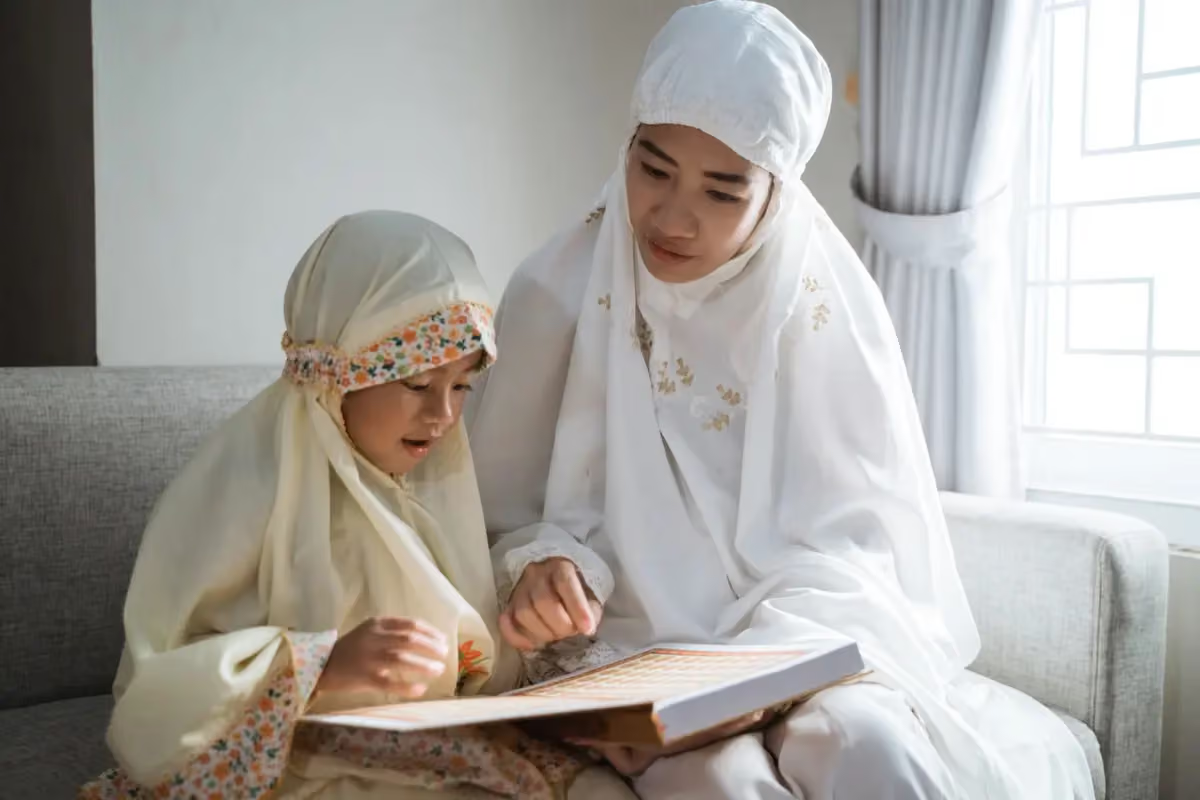
We would rather tell you exactly what we do than make claims we cannot back up. At Online Quran Lessons, every class is live and one-to-one with the same teacher each week. You choose a male or a female teacher, and the fee is the same either way. You can sit in on any class without telling us first, and lessons can be recorded for you on request. We arrange classes with the parent, and classes are supervised for teaching quality. If you are not comfortable with a teacher, tell us and we will change them at no cost.
If you want a teacher for a daughter, you may also like our page on female Quran teachers. And if you are choosing between academies, our guide on how to choose an online Quran teacher for your child goes deeper.
See it for yourself
The best way to judge whether a class feels right is to sit next to your child and watch one. Book 3 free trial classes, no card needed, and see how our online Quran classes for kids work in your own home.