

The short answer: make sure your child's Quran class is booked in your own local time, not the teacher's time or the academy's time. Then the class stays at the same clock time on your kitchen wall, whatever the clocks do. In the week the clocks change, send the teacher a one-line message confirming the time, and set a reminder on your phone for the first class after the change.
This guide is for Muslim parents anywhere the clocks go forward in spring and back in autumn, which includes most of the USA, Canada, the UK, Ireland, Europe, New Zealand and south-eastern Australia.
Why the clock change catches families out
Online classes connect two places at once. Your child is at home in Leeds, Dallas or Brisbane, and the teacher is somewhere else. If both places change their clocks on the same day, nothing moves. But many countries change on different dates, some change in opposite directions, and some never change at all.
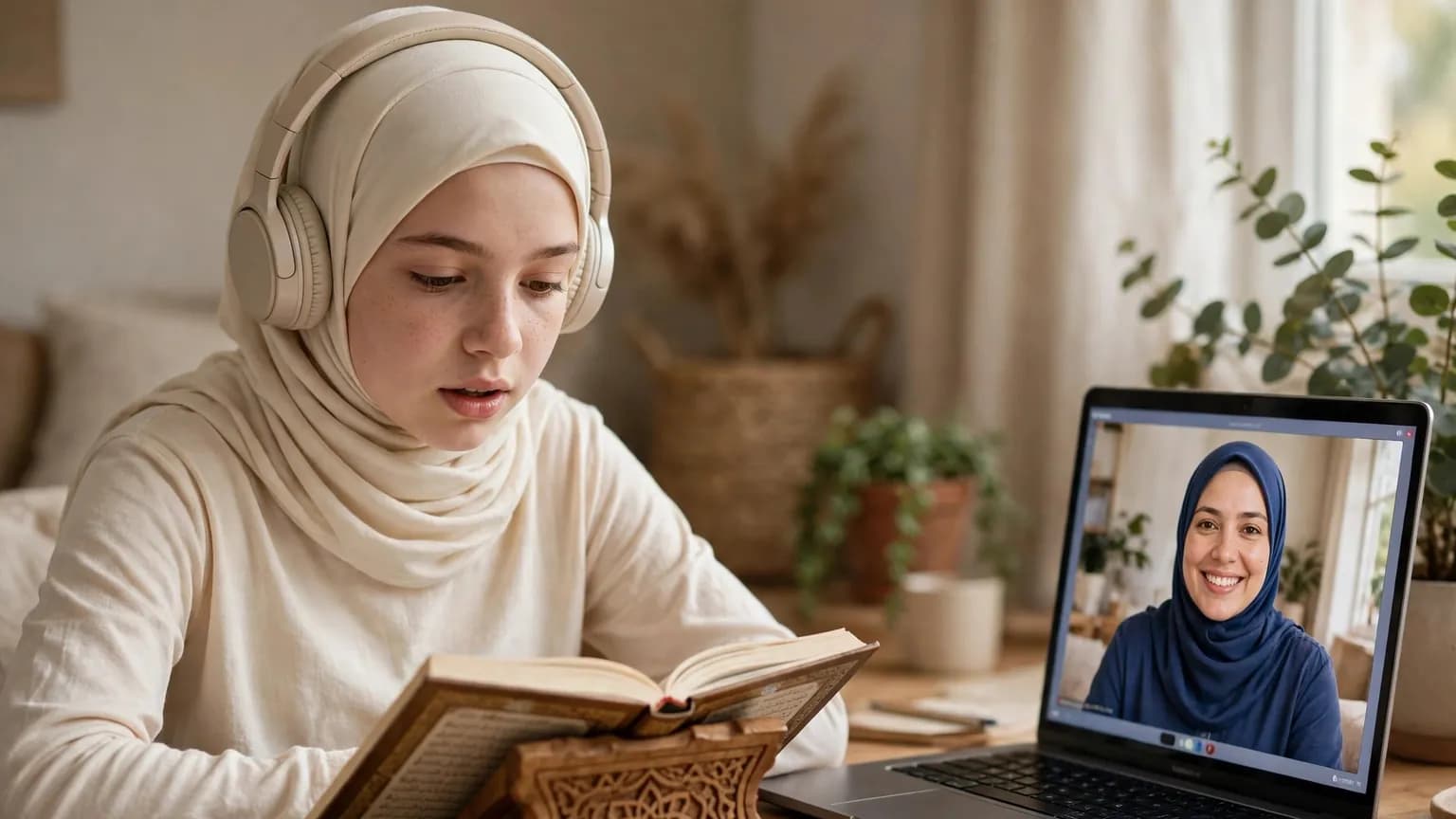
So if a class was booked as "5pm teacher's time" or "6pm UK time" when you actually live in Toronto, the class can suddenly start an hour earlier or later in your home. Children turn up to an empty screen, or miss the class because they were still at the park. A few missed lessons in a row can break a habit that took months to build.
When the clocks change in each region
The rules below are the usual ones. Governments sometimes change them, so check your local news if you are unsure.
| Region | Clocks go forward | Clocks go back |
|---|---|---|
| USA and most of Canada | Second Sunday in March | First Sunday in November |
| UK, Ireland and the European Union | Last Sunday in March | Last Sunday in October |
| New Zealand | Last Sunday in September | First Sunday in April |
| NSW, Victoria, ACT, Tasmania and South Australia | First Sunday in October | First Sunday in April |
A few places do not change at all: Queensland, Western Australia and the Northern Territory in Australia, most of Arizona and all of Hawaii in the USA, and most of Saskatchewan in Canada. If you live in one of these, your clock stays put, but the teacher's clock might not.
The awkward weeks
Because Europe and North America change on different Sundays, there are a few weeks each year when the gap between them is one hour smaller than usual: usually two or three weeks in March and one week around late October or early November. Families in the southern hemisphere have it even trickier, because Australia and New Zealand move their clocks in the opposite direction to Europe and North America, so the gap can change by two hours across the year.
You do not need to remember any of this. You only need one rule: your child's class time should be fixed in your own local time.
A simple checklist for parents
- Check how the class was booked. Look at your confirmation message or timetable. If it shows a time zone that is not yours, ask for it to be confirmed in your local time.
- Message the teacher in the week of the change. One line is enough: "Just confirming Ahmed's class is still 5pm our time on Monday."
- Set a phone reminder for the first class after the change. Ten minutes before is plenty. This catches any mix-up before your child sits down.
- Check your devices. Phones and laptops update by themselves, but older tablets, wall clocks and oven clocks may not. Children often go by the clock they can see.
- Watch the travel weeks. If you are visiting family abroad, tell the teacher the local time where you will be staying, especially if your trip crosses a clock change.
How it works at Online Quran Lessons

Classes run 24 hours a day, 7 days a week, and you choose the slot in your own time zone. A class at 4:30pm in Chicago stays at 4:30pm in Chicago before and after the clocks change, and a 6pm class in Melbourne stays at 6pm in Melbourne. Your child keeps the same teacher every week, so there is one person to message if anything needs checking.
If a class is missed because of a mix-up, talk to us rather than letting it slide. Our guide on what happens if a Quran class is missed explains how to handle it calmly.
Use the change to review the routine
A clock change is also a natural moment to ask whether the class time still suits your child. Darker evenings in autumn and lighter evenings in spring change how children feel after school.
When the evenings get dark
In autumn, the sun can set before school pick-up in the UK, Canada, the northern USA and much of Europe. Many children are more tired and less keen to sit at a screen after dinner. An earlier slot, soon after a snack and a short rest, often works better than a late one. Our guide to the best time for a kid's Quran class has ideas by age.
When the evenings get light
In spring and summer, children want to be outside until late. A class straight after school, before they go out to play, is often easier to protect than one in the middle of a sunny evening.
Prayer times move too
Salah times shift with the seasons, and the clock change makes the jump look bigger overnight. This is one reason we suggest pinning the Quran class to a fixed clock time rather than to Asr or Maghrib, which can move by hours over the year. Once your child knows "Quran is at 5pm on Monday, Wednesday and Friday", the habit survives every change of season.
Keeping young children calm about it
Little ones can find it confusing when bedtime suddenly feels early or late. Keep the Quran class at the same point in their afternoon or evening, even if the light outside is different. A short, predictable routine, such as a glass of water, wudu, sitting down with the Qaida and saying salaam to the teacher, helps the class feel normal on the first day after the change. Beginners usually start with Noorani Qaida, and a steady routine matters more at this stage than at any other.
Fees do not change with the clocks
Plans are one-to-one, 30 minutes a class, paid monthly. You choose 2, 3, 4 or 5 classes a week, and the pricing page shows the fees in your own currency. You can choose a male or female teacher at the same fee, sit in on any class, and ask for lessons to be recorded.
Getting started

The clock change does not need to cost your child a single lesson. Book the class in your own time, send one message in the week of the change, and keep the routine going. See how our online Quran classes for kids work, and when you are ready, book 3 free trial classes. No card is needed, and you choose the time in your own time zone from the very first class.
Frequently asked questions
Will my child's online Quran class move when the clocks change?
Why does the time difference with the teacher change during the year?
When do the clocks change in the USA, UK and Australia?
Should the Quran class be at Maghrib or at a fixed time?
What if we miss a class because of the clock change?
Keep reading
- For ParentsQuran Classes for Kids in Italy: Tempo Pieno, Saturday School and the Long Summer Break
- For ParentsQuran Classes for Kids in the Netherlands: Wednesday Afternoons, Moskee Classes and Holidays
 For ParentsWho Teaches Your Child? Our Quran Teachers, Their Qualifications and the Checks Behind Them