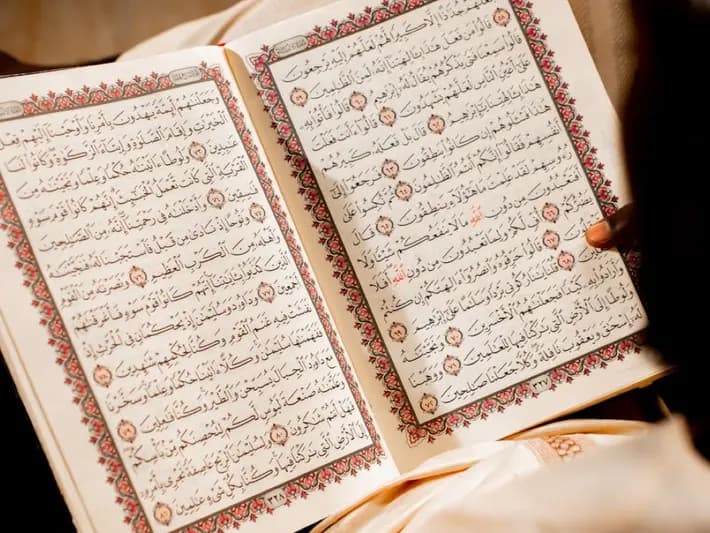
The short answer: in Tajweed, *tafkheem* means pronouncing a letter heavy (full, with the back of the tongue raised), and *tarqeeq* means pronouncing it light (thin). Seven letters are always heavy. Most letters are always light. Three letters change: Ra (ر), the Lam (ل) in the name Allah, and alif (ا).
The 7 letters that are always heavy
They are collected in the phrase خُصَّ ضَغْطٍ قِظْ (*khussa daghtin qiz*):
| Letter | Name |
|---|---|
| خ | Kha |
| ص | Sad |
| ض | Dad |
| غ | Ghain |
| ط | Ta |
| ق | Qaf |
| ظ | Za |
These are the letters of *isti'la* (raising): the back of the tongue rises towards the roof of the mouth. They are heaviest with a fatha, a little less with a damma, and lightest (but still heavy) with a kasra. The most common mistake for English and Urdu speakers is reading ص like س, ط like ت, or ق like ك. Our makharij chart shows where each one comes from.
When Ra (ر) is heavy and when it is light

- Ra with a fatha or damma is heavy: رَبِّ, رُسُل.
- Ra with a kasra is light: رِجَال, فِي ٱلرِّقَابِ.
- Ra with a sukoon looks at the letter before it. After a fatha or damma it is heavy (مَرْيَم, قُرْءَان). After a kasra it is light (فِرْعَوْن).
- Exceptions: a Ra sakin after a kasra stays heavy if a heavy letter comes straight after it in the same word, as in قِرْطَاس and مِرْصَاد. It also stays heavy when the kasra is not part of the word itself, such as the connecting hamza in ٱرْجِعِيٓ or a kasra at the end of the word before.
- When stopping on a Ra, look at the letter before it in the same way. After a kasra, or after a ya sakin, it is light: خَيْر, قَدِير. After a fatha or damma it is heavy: ٱلْقَدْر.
The Lam in the name Allah
The Lam in ٱللَّه is the only Lam that is ever heavy:
- Heavy after a fatha or damma: قَالَ ٱللَّهُ, عَبْدُ ٱللَّهِ.
- Light after a kasra: بِسْمِ ٱللَّهِ, لِلَّهِ.
Every other Lam in the Quran is always light.
Alif follows the letter before it

Alif has no weight of its own. After a heavy letter it is heavy (قَالَ, طَاغُوت). After a light letter it is light (كَانَ, نَاس).
Why it matters
Reading a heavy letter light, or a light letter heavy, can change how a word sounds and sometimes its meaning. For example, قَلْب (heart) read with a ك becomes كَلْب (dog). This is one reason a teacher who listens closely is so important in the early years.
How children learn it

Children pick this up best by ear, not by memorising rules. In our classes the teacher reads a pair such as صَبْر and سَبْر, the child repeats, and the teacher corrects on the spot. The rules above usually come later, once the sounds are already right. See also Tajweed rules for kids.
Our online Tajweed classes are one-to-one with a teacher who corrects every letter. You can book 3 free trial classes.